
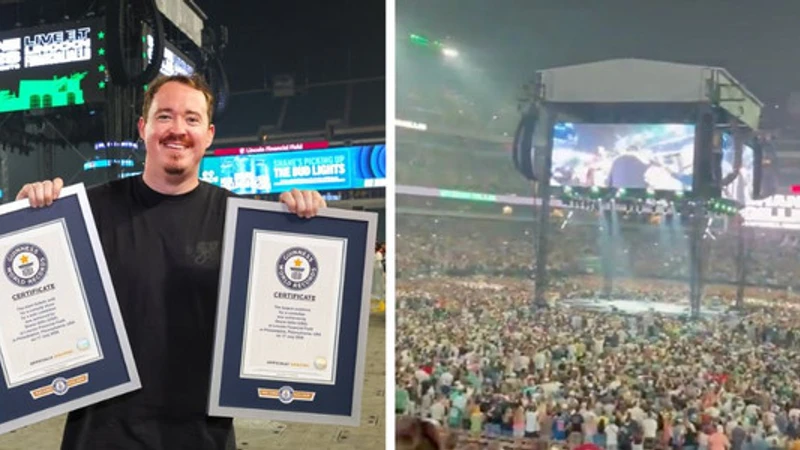
Shane Gillis took the stage at Lincoln Financial Field in Philadelphia on Friday night and turned an Eagles venue into the site of comedy history. The stadium reported that Gillis sold 77,047 tickets for the one-night show, with 73,946 fans packing the seats to watch him perform. Guinness World Records adjudicator Andy Glass was on hand to certify the moment, and Gillis walked away with two official titles in a single evening. He now holds the record for the most tickets sold for a comedy show by a solo comedian, and the record for the largest audience for a comedian, a mark that had stood since German comic Mario Barth drew 67,733 people in Berlin back in 2008.
For a man who was supposed to be finished before he ever began, it was quite a night.
Gillis is a Pennsylvania native, raised in Mechanicsburg, a graduate of West Chester University who cut his teeth in the clubs of Philadelphia before anyone knew his name. Friday's show was a homecoming in every sense. He brought out a parade of guests that read like a love letter to the region, including comedy legend Dave Chappelle, rapper Meek Mill, former Eagles center Jason Kelce, and current Philadelphia players who helped kick off the night. Even a Code Purple air quality warning, the product of wildfire smoke drifting down from Canada and Minnesota, could not keep the crowd away. As one fan told reporters outside the stadium, he would put on a hazmat suit before he would miss this show.
The triumph is all the sweeter because of where Gillis started. In 2019 he was hired as a cast member on Saturday Night Live and then fired days later, before he ever appeared on the show, after old podcast clips surfaced and the outrage machine demanded a scalp. The gatekeepers decided he was too offensive, too crude, too politically incorrect to be allowed near a mainstream audience. They were certain the public agreed with them. They were wrong.
What happened next is one of the great case studies in the failure of cancel culture. Rather than apologize his way into obscurity, Gillis went back to work. He built a following the old-fashioned way, through relentless touring, a hit podcast, and a comedic voice that refused to bend to the sensibilities of people who were never going to be his fans anyway. Over the past two years he has performed more than 100 headline shows, sold over 1 million tickets, and set 34 venue records along the way. He landed a Netflix series, a stand-up special, and hosting duties for the network's Roast of Kevin Hart. The stadium in Philadelphia was simply the exclamation point.
There is a lesson here that goes well beyond comedy. For years, Americans have been told that certain jokes, certain opinions, and certain people are simply beyond the pale, and that the institutions of entertainment would decide who was permitted to succeed. Gillis represents the collapse of that arrangement. Audiences, not executives, are once again deciding who deserves the stage. When ordinary people are given a real choice, they tend to reward talent and authenticity over the approval of cultural commissars. Seventy-seven thousand tickets is a referendum, and the verdict is not close.
In fairness, plenty of critics still find Gillis coarse, and they are entitled to that view. His humor is deliberately provocative, it traffics in material that many Americans would not repeat at the dinner table, and reasonable people can decide his comedy is not for them. Some will argue that record ticket sales are a measure of marketing muscle and celebrity guests rather than pure stand-up merit, and it is true that a lineup featuring Chappelle and Meek Mill draws a crowd on its own. Comedy has always had its gatekeepers and its skeptics, and Gillis is not the first performer whose success the tastemakers found distasteful. Those objections deserve a hearing.
But the numbers do not lie, and neither does a stadium full of paying customers who braved smoke-choked skies to be there. The people who tried to end this man's career in 2019 assumed they spoke for the country. Friday night in Philadelphia proved they never did.
Gillis is not slowing down. His tour rolls on with a stop in the Charleston, South Carolina area on August 8, and given his pace over the last two years, the records he just set may not last long. Whatever comes next, the message from Lincoln Financial Field is unmistakable. The audience has spoken, the culture is shifting, and the folks who once held the keys to the gate are finding out that the gate no longer matters.
White Boy Summer, indeed.
- Article Source:
The Post Millennial

- Photo:
