
The Associated Press called it Wednesday evening.
Initiative 638 passed in Washington state with roughly 56 to 57 percent of the vote. It bars students who are biologically male from competing on girls' K-12 sports teams, reversing longstanding state guidance.
It is the first time in American history that voters, rather than a state legislature, have directly enacted a law separating boys and girls in school sports.
Not Alabama. Not Texas. Washington.
The split-ticket number is the entire story.
Tuesday was a blue wave nationally and Washington was no exception. Democrats carried essentially everything on that ballot.
And then the same voters, with the same pen, approved this by fourteen points.
An opponent of the measure put it bitterly and accurately: everyone is talking about a blue wave of progress, and in that wave this got swept in with the tide.
That is not a conservative spin. That is the other side describing what happened.
Two measures from the same sponsor did not pass. An initiative to repeal the state's millionaires tax was losing. So was one rewriting the parents' bill of rights.
So this was not a general rightward lurch in Washington. Voters rejected the tax measure, rejected the parental rights measure, elected Democrats, and passed this one anyway.
They were not voting a party line. They were voting on this specific question.
If you have been reading us this fall, you know how we got here.
A Seattle Storm co-owner confronted two sixteen-year-old girls over a sign at a game. The league suspended her five games.
A Seattle Times sports columnist wrote about those girls. His paper refused to run it. He resigned after eleven years.
A Battle Ground High School runner named Elise Bierer walked off a cross-country course alone rather than compete, costing her team its score, after a runner who had opened the season ranked 76th in boys' junior varsity finished second in the girls' district championship.
A fifteen-year-old wrestler went to the Supreme Court this fall asking for advance notice and the ability to decline a match.
Twenty-five people in XX-XY shirts were surrounded, struck with flagpoles and removed from a Portland stadium while security escorted out the people who got hit.
Every one of those happened in the Pacific Northwest. All of them in about eight weeks.
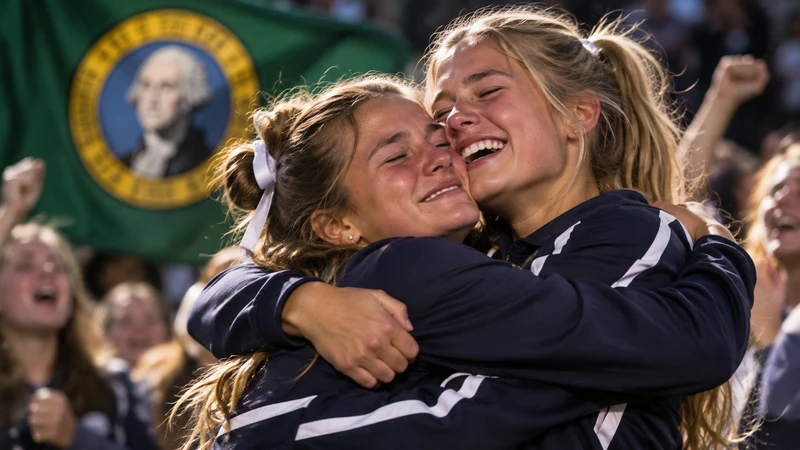
That columnist, Matt Calkins, now at OutKick, covered Tuesday's result. There is a photograph from the watch party of student athletes Ahnaleigh Wilson and Frances Staudt embracing when it became clear the measure would pass.
Wilson is one of the girls who was confronted at the Storm game.
Now the part worth taking seriously, because it is a real objection.
The initiative requires students seeking to play on girls' teams to complete a biological sex verification during a routine sports physical. Opponents say that means genital exams, hormone tests or chromosome testing for every girl who wants to play.
That is a legitimate concern and it deserves a straight answer rather than a dismissal.
The Washington Interscholastic Activities Association, which governs school athletics in the state, says its current rules require none of those things as part of a sports physical. How the measure gets implemented will determine whether the objection proves accurate or not, and that implementation is going to be written by regulators and probably litigated.
Conservatives should want that done carefully. We have argued all year that the goal being right does not excuse bad execution, and an invasive rollout would hand opponents exactly the story they have been predicting.
Get the policy. Then get the implementation right, publicly, with the WIAA saying plainly what is and is not required.
And the scale, honestly.
The WIAA estimates roughly ten transgender athletes compete in school sports across a state of eight million people.
Opponents raise that number constantly, and it is a fair thing to raise. It is also, we would note, not actually an argument about the principle. A rule is either correct or it is not, and the number of cases it governs does not change that. Most laws govern rare events.
What Washington actually demonstrated.
For years the assumption in American politics has been that this issue belongs to one party and that supporting it is a red-state position.
Fifty-six percent of voters in Washington state, on a night they elected Democrats to nearly everything else, said otherwise.
That is not a partisan result. That is a consensus result that happened to be inconvenient for the people counting the rest of the ballots.
The girls in that photograph were not running a campaign. They showed up at games with signs and got yelled at for it.
A million and a half Washingtonians eventually agreed with them.
- Article Source:
Based Apparel

- Photo:
