
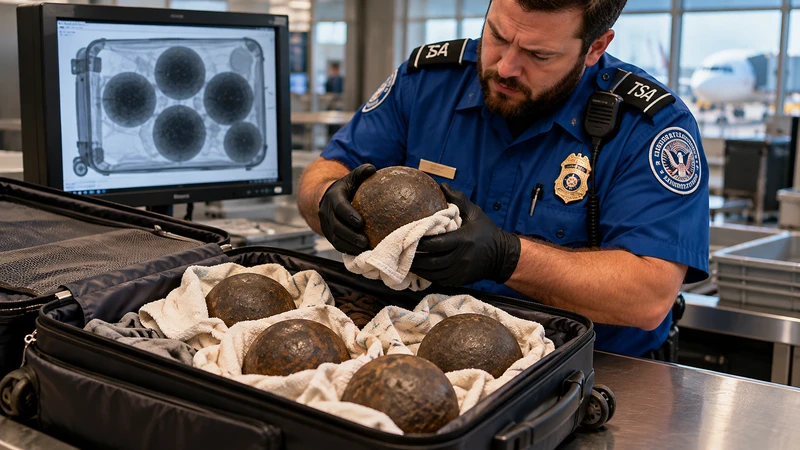
A TSA officer at Gulf Shores International Airport in Alabama pulled a checked bag off the belt after seeing a large opaque mass on the X-ray.
Lead officer Justin Dupree's first guess was a medicine ball.
He opened the suitcase and found five cannonballs wrapped in paper towels.
Wrapped. In paper towels. Like leftovers.
The quote of the year came next.
Dupree described the moment to the agency's own newsletter.
"I couldn't see the entire item but was scared I might have been holding a live explosive."
His supervisor, Richard Cash, added the line that should be on a plaque somewhere in that terminal.
"I've seen inert grenades and training munitions but never an Indiana Jones-esque stolen artifact-type situation."
That man has waited his entire career to say a sentence like that and he absolutely earned it.
So how did five Civil War cannonballs get into a suitcase in Gulf Shores?
Investigators traced them to Fort Morgan, the historic coastal fort down the road that guarded Mobile Bay during the Civil War.
According to the Baldwin County Sheriff's Office, a juvenile took them out of a storage area at the fort and put them in his grandmother's checked bag.
She told officers she had no idea they were there.
Picture that conversation. A woman who has packed one cardigan too many is standing in an Alabama airport while federal officers remove ordnance from her luggage, and somewhere nearby a teenager is looking at his shoes.
On the kid's behalf, briefly.
Honestly? Respect.
Every American boy who has ever walked through a historic fort has had exactly one thought, and that thought is: could I take one of these home.
The answer has always been no, because of adults and glass cases and signs. This young man encountered a storage area, apparently unlocked, with cannonballs in it, and he did what the entire male population of this country would have done at thirteen.
He simply failed to consider the final step, which is that the federal government X-rays everything leaving Alabama.
Fort Morgan declined to press charges. The cannonballs went home to the fort.
The hardware specs, because they are satisfying.
The largest was about the size of a grapefruit and weighed roughly as much as a shot put.
All five were completely inert. No powder, no fuse, no active components. These things have been sitting around since Grant was a general.
TSA still had to confiscate them, and the agency is right about that. Cannonballs are artillery munitions, and prohibited items are prohibited items regardless of whether they have been dormant since Appomattox.
Here is the part worth appreciating.
The TSA takes a historic amount of mockery in this country. Some of it is deserved. Anyone who has surrendered a four-ounce bottle of contact solution while a man ahead of them carries an entire rotisserie chicken through the scanner knows the feeling.
But this summer the agency has been screening more than two million people a day, and in that same stretch it has pulled two live smoke grenades, an inert grenade, a pipe bomb look-alike, and a samurai sword concealed in a guitar case.
A samurai sword. In a guitar case. Somebody did that on purpose.
Against that field, a man staring at a grapefruit-sized iron sphere on a screen in Gulf Shores and thinking medicine ball is a reasonable professional day.
The real lesson.
Check your grandmother's bag.
Not because of her. She is fine. She packed sensible shoes and a paperback.
Check it because a thirteen-year-old with access to an unlocked storage room at a Civil War fort has a plan, and that plan ends at a TSA checkpoint whether he has thought it through or not.
Five cannonballs. Paper towels. Grandma.
Somewhere in Alabama there is a young man who is going to tell this story for the next sixty years, and every single time, it is going to kill.
- Article Source:
Based Apparel

- Photo:
