
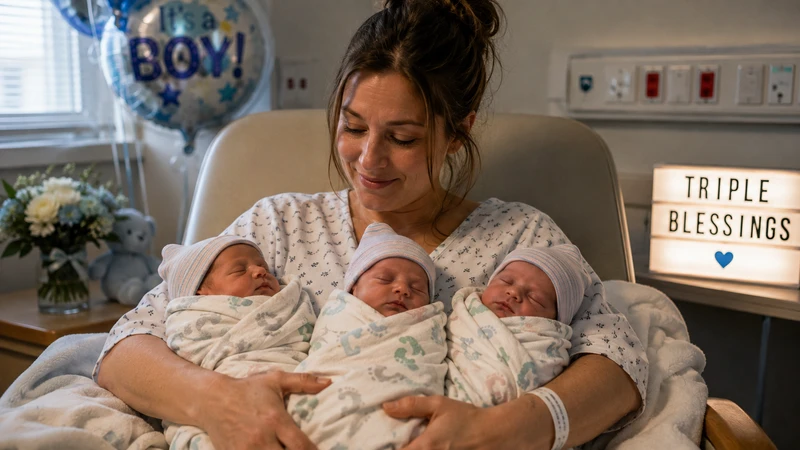
In November 2024, a Florida woman named Kyla Simpson gave birth to triplet boys. They were not hers. She had carried them under a surrogacy arrangement for Ted Zhou, a single man in China who had commissioned the pregnancy.
Zhou did not show up.
He explained later that he was having trouble getting a United States visa. So Simpson took three newborns home and began raising them. She fed them. She nursed them. She waited for the man who had ordered them to come and get them, and as the weeks stretched into months she started noticing things. He had not given any of the boys his surname. The money he had promised for their care arrived late, and only after she asked for it. In her words, her soul felt uneasy.
Five months after the birth, according to reporting in New York Magazine, Zhou emailed to say he was sending people. Days later two men pulled up to her house in a black SUV, told her they knew she had the boys, and claimed to hold power of attorney. Zhou called her dozens of times. He warned her that police would arrest her. Then he brought up her five year old daughter and suggested she might grow up without her mother.
Simpson drove to the courthouse in St. Augustine and called the FBI.
That is where a story about paperwork becomes a story about what we have allowed to be bought and sold. Simpson came to believe she had been used by a ring that commissions babies from American wombs and moves them somewhere else. Nothing has been proven, and Zhou has not been convicted of anything. But sit with the fact that a woman had to consider it seriously, because the arrangement itself gave her no way to know who she had been dealing with.
Here is the part that ought to end the debate about whether commercial surrogacy is a market like any other. In August 2025, one of the three boys became seriously ill and died. The two survivors are now living in what has been described as a nanny house in Southern California while lawyers argue. The order of parentage Zhou obtained in California came after the babies were born. Simpson put her own name and her husband's on the birth certificates, which she says she did to get the boys medical coverage. Both sides have a legal tangle. Neither side has the children. Reporting on the case raises the real possibility that when the gavel finally falls, custody goes to nobody at all.
Two little boys, alive, in a house with paid staff, waiting for a court to decide which adult's claim is stronger.
This is not a glitch in an otherwise sound system. It is the system working exactly the way a market works when the product is a person. American women gestate thousands of children every year for buyers overseas, and by New York Magazine's account, nearly half of those buyers are in China. Contracts get signed. Fees get wired. Embryos get shipped between jurisdictions with conflicting laws, so that when something goes wrong there is no clear answer to the only question that matters, which is who these children belong to.
Conservatives have argued for a long time that a child is not a commodity, that motherhood is not a service to be contracted out, and that a country which permits its women to be rented and its infants to be ordered by catalog will eventually be handed a case exactly like this one.
It has been handed one. Three boys were ordered. One is dead. Two are waiting. And the men who write the contracts are still writing them.
- Article Source:
news.basedapparel.com

- Photo:
