
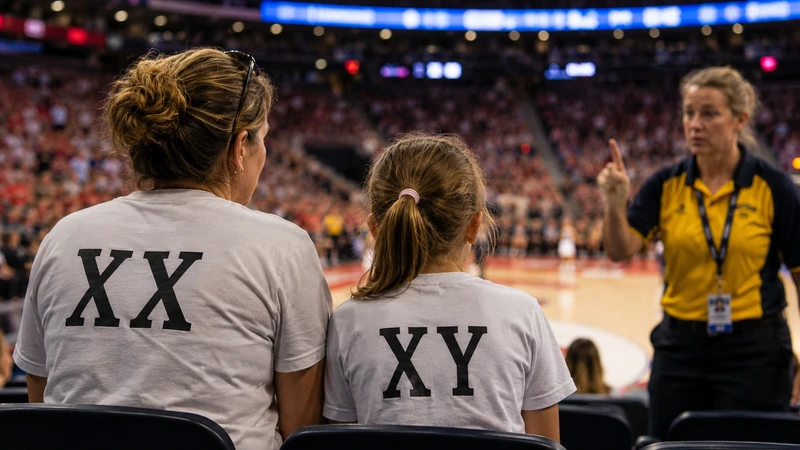
Kasey Thomason and her seventeen year old daughter Annie bought good seats. A few rows off the floor at State Farm Arena in Atlanta on Sunday night, Fever at Dream, one of the best games of the season. They wore XX-XY Athletics shirts. Kasey's had the letters done in stars and stripes. Annie's was a Riley Gaines collaboration, XX on the front, For the Girls on the back.
They sat there through four quarters without a word from anyone. Fans around them liked the shirts. Then the game went to overtime, and somewhere in the middle of a five minute period, arena security arrived with an offer.
Cover up, or leave.
The guard explained that a fan had been offended. He did not cite a policy. He did not point to a rule. He offered them a pair of promotional shirts and a choice between wearing them and being escorted out of the building. Kasey asked whether biology and science were now offensive, which is a fair question and did not receive an answer. With about ninety seconds left in overtime, on the ESPN broadcast, you can watch a mother and her teenage daughter pull on the shirts they were handed so they could stay and watch the end of a basketball game.
Here is the part that should be framed and hung in a museum of unintentional comedy.
Sunday was Wellness and Health Night. The Dream partnered with Emory Healthcare for an evening dedicated to improving health outcomes for women and girls across Georgia. The shirts the Thomasons were forced to put on were the Wellness and Health Night shirts.
They made two women cover up a message about women in order to comply with a promotion about women.
Now let us talk about the rule, because there wasn't one. State Farm Arena's prohibited items list bars clothing with explicit language, profanity, or derogatory characterization of any person. The NBA's fan code of conduct bars obscene or indecent messages. Four letters and the phrase For the Girls does not clear any of those bars. It is not profane. It does not name anyone. It is not indecent unless the alphabet has been reclassified.
So what standard was actually applied? Someone complained. That is the entire test. Not the written policy the arena publishes, but whether a nearby ticketholder registered displeasure. That is not a dress code. That is a heckler's veto, and once it exists, the shirt you are allowed to wear depends entirely on who is sitting next to you.
The Thomasons believe the complaint came from a fan seated nearby wearing a shirt with a message of her own, one that had been shown on the video board earlier in the evening. They say they never saw her asked to change, though they noticed her jacket was zipped by the end. That is their account, and the Dream has not responded to a request for comment, so take it as what it is. But you do not need to resolve who complained to see the problem. Two messages were in the building. One got the video board. The other got a security escort.
This is also not new. Less than a month ago a Seattle Storm co-owner went after two teenagers wearing the same brand, courtside, and reduced one of them to tears. The league suspended her five games and fined her. Which means the WNBA has already ruled that harassing kids over these shirts is misconduct. Apparently that ruling did not make it to Atlanta.
There is a simple fix available here, and it costs nothing. Publish the rule. Apply it to everybody. If XX-XY shirts violate the code of conduct, say so in writing before people buy tickets. If they do not, then leave the customers alone.
A seventeen year old girl went to a basketball game wearing a shirt that said For the Girls, and a professional women's basketball team made her take it off.
Let that sentence sit there for a while.
- Article Source:
FOX News

- Photo:
