
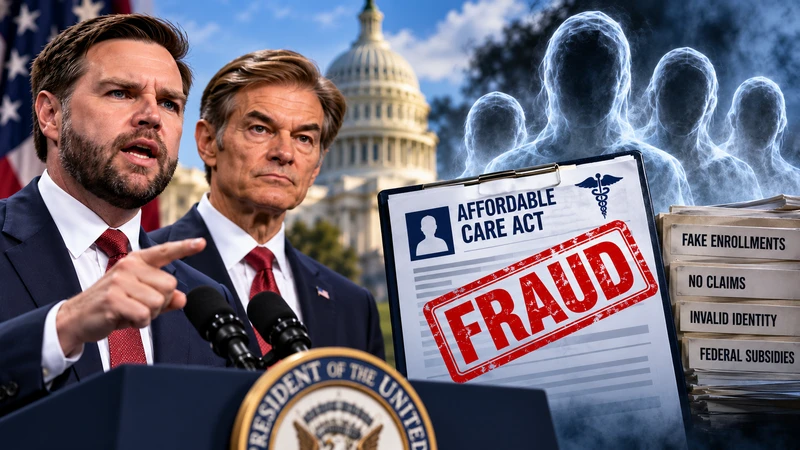
Vice President JD Vance and CMS Administrator Dr. Mehmet Oz announced Tuesday that roughly 750,000 people are being removed from Affordable Care Act coverage over what the administration says were fraudulent enrollments. CMS is canceling about 315,000 unauthorized enrollments affecting more than 760,000 people, with an estimated $2.2 billion in savings.
Another 419,000 enrollees will face additional verification of legal residency and income.
Oz's description of the removed enrollees was memorable. These are not real people, he said. We are not paying insurance for non-existent ghosts.
The design flaw is the story, and it is almost impressively dumb.
Here is how Vance described the setup. Brokers were paid commissions for enrolling people. Eligibility standards were loosened at the same time. And nobody was checking whether the loosened standards were being met.
Read that as a sentence and it explains itself. You pay people per signup, you relax the requirements for a valid signup, and then you decline to audit the signups.
That is not a loophole. That is a business model with a government subsidy attached.
The Wall Street Journal reported that 40 agents and brokers alone generated 50,000 fake enrollments, costing $45 million. Since January, CMS says it has terminated more than 200 non-compliant agents and brokers, and there is now a six-month moratorium on new ones.
Forty people. Fifty thousand enrollments. Nobody noticed until somebody went looking.
The profile of a phantom.
According to CMS, the flagged accounts share a pattern: enrolled with the help of a broker, never filed a single claim, entire monthly premium covered by federal tax credits, and either no Social Security number or immigration documents the agency could not verify.
Oz says CMS tried to reach them. They wrote. They FedExed. He also said they tried telexing them, which we assume was a figure of speech, because if the federal government is still running telex machines that is a separate article.
Nobody answered.
Now the part we are going to be careful about, because we have been careful about it all year.
We have written repeatedly that rushed verification systems catch legitimate people. We said it when Texas flagged 2,724 voter registrations through a federal database and had to reinstate citizens who had already proven citizenship to the state. We said it when the Postal Service tried to implement an untested ballot verification portal, and the Supreme Court struck it down 7 to 2.
The same principle applies to a friendly administration.
Two of the statistics being cited deserve a harder look. Oz said 35 percent of exchange enrollees have never used their insurance, and called that proof of fraud. It might be. It is also, in plain terms, a description of healthy people who bought insurance and did not get sick. That is what insurance is for. He argues the rate is twice what you would normally expect, which is a real argument, but it is an inference rather than a finding.
And having no Social Security number on file is a red flag, not a verdict. Health policy experts have said fraud in the ACA is real while questioning the scale being claimed. Reporting also notes it is unclear whether the removed enrollees were paying premiums.
If even a small fraction of 760,000 people are real Americans who genuinely had coverage, then somewhere this week a family is finding out at a pharmacy counter.
So here is the ask, and it costs the administration nothing.
Publish the appeals process. Make it fast, make it simple, and staff it. Anyone wrongly removed should be able to demonstrate eligibility and be restored in days rather than months.
If the 750,000 really are phantoms, an appeals line will sit empty and the administration gets to prove its case twice. If the line rings, we learn something important before it becomes a story about a diabetic in Ohio who could not fill a prescription.
Four in one week.
Twelve people charged in San Diego over daycares that billed $10 million for children who were never there. A Fort Worth daycare with sixteen state citations still operating. An Arizona Medicaid scheme that billed for dead patients and cost taxpayers $2 billion while the people it was supposed to treat ended up homeless. And now 760,000 enrollments the government cannot verify.
Different agencies, different states, one identical failure. We build enormous programs, pay intermediaries per transaction, verify almost nothing, and then express astonishment when the transactions turn out to be fictional.
The phantoms did not break into the system.
They were invited, with a commission check.
- Article Source:
The Post Millennial

- Photo:
