
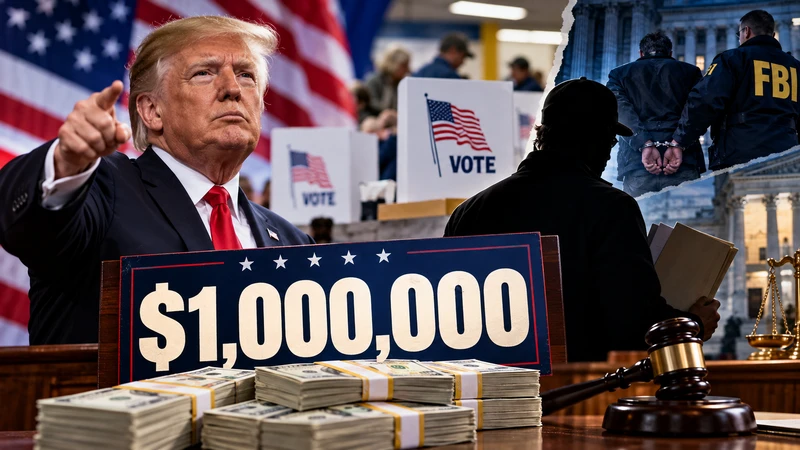
On October 26, President Trump announced a one million dollar reward for anyone whose report of voter fraud leads to an arrest and conviction. It covers past elections and Tuesday's midterms.
Constitutional Rights PAC built VoterFraudReward.com to take those reports and get them to people who can actually do something with them.
Election Day is Tuesday. Before then, a few things are worth understanding, including one that could land you in handcuffs if you get it wrong.
First, why this is a real tool and not a stunt.
Paying citizens to report crimes they witnessed is one of the oldest enforcement mechanisms in American law.
Abraham Lincoln signed the False Claims Act in 1863 because contractors were robbing the Union Army blind and the War Department could not catch them from the outside. The law pays private citizens a cut of whatever the government recovers. It has brought back tens of billions of dollars since.
The IRS runs a version. The SEC runs one that has returned billions.
All three exist for the same reason. Some crimes are invisible unless somebody inside talks.
Election fraud is that kind of crime. Nobody commits it by wandering into a polling place and improvising. It happens in registration processing, in ballot handling, in the counting room, by people with keys and logins. The person most likely to see it is standing right next to the person doing it.
That is exactly who these programs are built to reach.
And the structure handles the obvious objection.
The reward pays on arrest and conviction.
Not on an allegation. Not on a complaint. Not on a shaky video somebody filmed from a parking lot.
A conviction. Obtained by a prosecutor. In a courtroom. Under the rules of evidence.
Which means the program cannot generate false accusations, because false accusations do not produce convictions. If it turns out there is nothing to find, nobody gets paid and the taxpayer is out zero dollars.
That is a feature. Any reward program that paid out for accusations would drown in them within a week.
Now the part where we talk to you like adults.
Do not confront anybody on Tuesday.
Not a voter. Not a poll worker. Not a guy in the parking lot you think looks suspicious.
You are not a cop. You have no authority to ask for ID, block a door, follow a car, film someone at close range, or question a person about their ballot. Voter intimidation is a federal crime under Section 11(b) of the Voting Rights Act, and it does not require you to threaten anybody. Standing too close and being aggressive about it will do.
Here is the practical version. If one conservative gets arrested Tuesday for harassing a voter, that photograph runs for a week, and it will do more damage to this cause than any single fraudulent ballot ever could.
Do not be that photograph.
Also, leave the poll workers alone. The overwhelming majority of them are retirees making a small stipend to run a precinct in the neighborhood where they live. They are not operatives. They are your neighbor's grandmother with a laminated badge and a folding table.
What a useful report actually contains.
If you see something real, write down three things.
Where. The precinct, the county, the office, the street address. Not the state. The location.
When. Date and time, as close as you can get.
What proof. Did you see it with your own eyes or did somebody tell you? Do you have a photo, a document, a text, a name, a vehicle? Secondhand speculation goes nowhere with a prosecutor. Firsthand specifics go somewhere.
The categories that count are fraud at a polling place, fraud with mail ballots, fraud in voter registration, and fraud in the counting process.
"I heard they bus people in" is not a report. "At 2:40 p.m. on November 3, at this address, I watched this specific thing happen and here is a photograph" is a report.
The honest framing.
We have written a lot this year about how verification systems go wrong. Texas flagged 2,724 registrations through a federal database and had to reinstate citizens who had already proven citizenship to the state. The Supreme Court struck down the Postal Service ballot rule 7 to 2 because the agency never had the authority. Thirty thousand self-declared noncitizens got onto rolls across eleven states, almost all of it traceable to DMV coding errors rather than any plot.
The lesson every time was the same. The goal was right. The execution decided whether the goal survived.
This program has a conviction trigger and a real intake process. That is the version that holds up.
Four days.
Report it at VoterFraudReward.com. Pick your state, hit continue, tell them what you saw.
Then go vote, because early voting has closed almost everywhere and Tuesday is what is left.
Watch the process. Then participate in it. In that order, both of them.
- Article Source:
news.basedapparel.com

- Photo:
