
Everybody has an opinion about artificial intelligence. Almost nobody is asking the boring question.
Who is paying for all of this?
The answer, increasingly, is nobody. Not yet. It is being financed, and the people lending the money are starting to get nervous.
Start with Oracle, because Oracle is the clearest case.
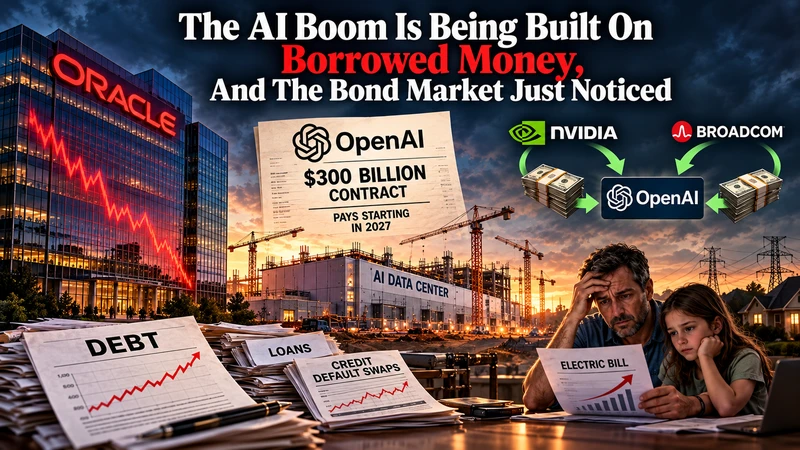
Oracle has nearly doubled its long-term debt to more than $160 billion over the past two years, according to Bloomberg. The company is now the fifth-largest borrower in the entire United States corporate bond market.
Its capital spending hit $28.5 billion in a single quarter. Two years ago, the same quarter was $2.3 billion.
Free cash flow has gone negative. The stock is down roughly thirty percent this year. S&P cut the credit rating to BBB-, which is one notch above junk.
And the cost of insuring Oracle's debt against default, measured by credit default swaps, recently hit a record for the company at nearly 300 basis points.
That is the bond market saying out loud what nobody at a tech conference will say.
Here is the part that should make you sit up.
Oracle's largest customer is OpenAI. The contract is reportedly worth $300 billion, roughly half of Oracle's entire $638 billion backlog.
OpenAI does not start paying until 2027.
So Oracle is borrowing now, at scale, to build facilities now, for a customer who begins paying roughly $60 billion a year starting more than a year from now.
S&P put the risk in language a banker would recognize. If OpenAI cannot pay, the data centers will sit idle while operations, maintenance and depreciation continue, leaving Oracle with massive leases it might be unable to exit.
Meanwhile OpenAI's annualized revenue was recently reported to be running about twenty billion dollars short of prior estimates.
It gets stranger. The suppliers are financing the customers.
Nvidia has guaranteed part of an OpenAI affiliate's buildout. Broadcom has reportedly arranged debt so that OpenAI can buy Broadcom's chips.
Read that again. Chip companies are lending money to the people buying the chips, so that the people buying the chips can buy the chips.
That is not a supply chain. That is a company financing its own revenue, and anyone who was conscious in 1999 has seen the slide deck before.
And the hardware keeps getting better, which is somehow a problem.
Here is the structural trap. AI chips improve faster than data centers can be built.
OpenAI reportedly walked away from expanding Oracle's flagship Stargate site in Abilene, Texas because it wanted newer Nvidia hardware at different locations.
So the building financed with twenty-year debt is holding chips that are obsolete in three. You cannot refinance the mortgage on a warehouse full of equipment nobody wants.
Banks have noticed. TD Cowen reports that a number of American banks have pulled back from Oracle-linked data center projects, and that where they will still lend, the borrowing costs have gone up. Blue Owl, previously a reliable Oracle partner, declined to fund a ten billion dollar Michigan project.
Now connect it to your electric bill.
We wrote last week about Ohio, where data centers already consume enough electricity to power more homes than exist in the state, and where analysts project sixteen billion dollars in higher costs for ratepayers between 2027 and 2034.
Put the two stories side by side.
The AI buildout is being financed with debt that the bond market is now pricing as nearly junk, and the electricity to run it is being subsidized by households through their utility bills, in states that also handed out tax exemptions to attract the facilities.
Private debt, public power, public risk.
If the revenue arrives on schedule, everyone looks brilliant. If it does not, the bondholders take a haircut, and the ratepayers are still holding the grid upgrades.
We are not predicting a crash.
We do not know and neither does anyone writing confidently about it in either direction. AI may well generate enough revenue to cover all of this. The technology is real, the demand is real, and plenty of people who called bubbles in 1996 missed a decade of gains.
But a few things are facts rather than forecasts.
Oracle is one notch above junk. Its default insurance is at a record. Its biggest customer does not start paying until 2027 and is reportedly behind on revenue projections. Suppliers are lending customers the money to buy their products. And American families are paying higher electricity bills to power it.
Conservatives spent 2008 learning what happens when everyone agrees the financing is fine.
The least we can do this time is read the loan documents.
- Article Source:
news.basedapparel.com

- Photo:
