
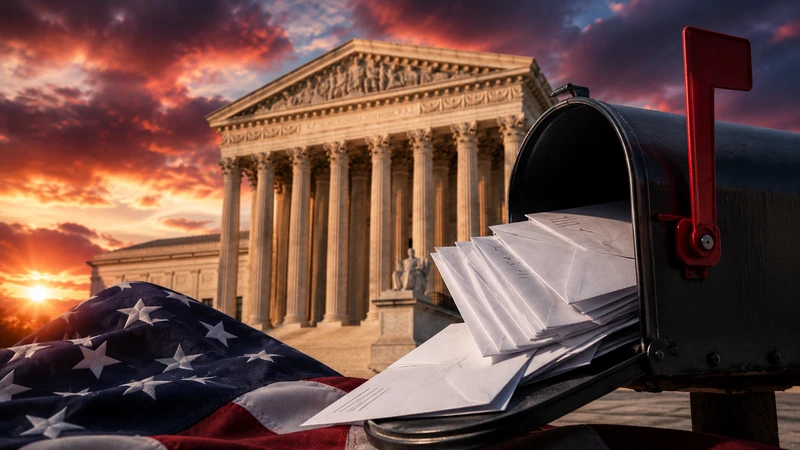
For millions of Americans, Election Day has always represented a simple principle: when the polls close, the votes are counted, and the people receive the results.
The Supreme Court's latest ruling has left many conservatives wondering whether that principle is slowly being erased.
In a narrow 5-4 decision, the Court upheld a Mississippi law allowing absentee ballots that are mailed by Election Day to be counted even if they arrive days later. The ruling rejected a challenge brought by the Republican National Committee, which argued that federal law requires elections to be decided on Election Day—not afterward.
Justice Amy Coney Barrett authored the majority opinion, joined by Chief Justice John Roberts and the Court's three liberal justices.
Writing for the majority, Barrett argued that federal election statutes do not specifically require ballots to be received by Election Day and that the Constitution gives states broad authority to administer elections unless Congress clearly says otherwise.
For conservatives, however, the ruling raises troubling questions about confidence in America's elections.
Election Day should mean exactly that—Election Day.
Supporters of stricter election laws argue that extending ballot deadlines weakens public confidence, delays final results, and creates unnecessary opportunities for disputes. They contend that clear deadlines promote transparency, consistency, and trust in the electoral process.
Justice Samuel Alito expressed those concerns in a forceful dissent joined by Justices Clarence Thomas, Neil Gorsuch, and Brett Kavanaugh.
Alito acknowledged that early voting and voting by mail have become common across the country. But, he argued, those conveniences should not alter what federal law requires.
According to Alito, regardless of how citizens cast their ballots, the nation's collective decision should still be determined on Election Day—not in the days that follow.
That argument resonates with many Americans who believe elections should have firm, uniformly enforced deadlines. In virtually every other area of life, deadlines matter. Tax filings, court submissions, and legal documents all have strict cutoff dates. Conservatives argue that the nation's elections should be no different.
The Court's decision is likely to intensify the ongoing national debate over election laws as states continue to adopt different rules governing absentee ballots, early voting, and ballot counting procedures.
For supporters of stronger election integrity measures, the ruling represents another reminder that meaningful reform may ultimately have to come from Congress and state legislatures rather than the courts.
The debate over how America conducts its elections is far from over. But for many conservatives, one question remains unanswered:
If Election Day no longer marks the final deadline for counting ballots, what exactly does Election Day mean?
- Article Source:
The Post Millennial

- Photo:
