
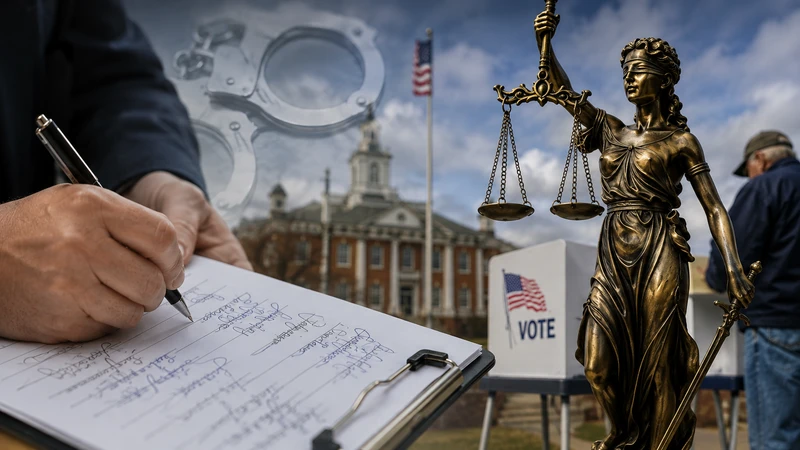
There is a particular kind of political story that restores your faith in the essential comedy of the universe, and Burlington County, New Jersey has delivered one.
Gina LaPlaca, the former mayor of Lumberton Township, was charged this week along with her husband Jason Carty in connection with the nominating petition that put her on the ballot for the June Democratic primary. The charges from the county prosecutor include making a false statement under oath, knowingly filing a false petition, and tampering with public records. Carty faces his own set. Both are due in court in Mount Holly on September 21, and both are entitled to the presumption of innocence, which we will extend more generously than the modern Democratic Party typically extends it to anyone else.
Here is the allegation. Investigators say they contacted people whose names appeared on the petition, and that a number of them reported they had never signed it and had never authorized anyone to sign for them. Prosecutors say that without those signatures, the petition would have fallen short of the number required to qualify her for the ballot at all.
Now for the part that belongs in a museum.
She still lost.
Two seats were open on the township committee. LaPlaca finished third. Whatever effort allegedly went into the paperwork, the voters of Lumberton Township reviewed the candidate, considered the field, and placed her outside the winner's circle by their own free hand. Somewhere there is a lesson about the limits of cheating, and it is that cheating only helps if people also want to vote for you.
The affidavit is the detail that elevates the whole affair. The form she signed attested that she personally circulated the petition and that it had been "signed by each of the signers thereof in his/her own handwriting." That is not a technicality buried in a subsection. That is the entire purpose of the document. The sworn statement is that you watched it happen. If the allegations hold up, the offense was not hidden in the fine print. It was the fine print.
This follows a guilty plea earlier this year in a case that was not funny at all. LaPlaca admitted to driving under the influence with her child in the vehicle, at a blood alcohol level more than three times the legal limit, and received three years of court supervision. That is a serious matter involving a child, and it will not be treated here as a punchline. It is context, and voters are entitled to weigh it.
The larger point is worth making without hysteria. Ballot petitions are not the same thing as votes, and nobody should confuse the two. But they are the front door of the entire process, the paperwork that determines whose name a voter ever sees, and that door is guarded almost entirely by sworn attestations that hardly anyone checks. It took a county prosecutor's investigation to find out whether the signatures were real. Credit where it is due, the system caught this one. The uncomfortable question is how often nobody thinks to look.
For years, conservatives raising concerns about election paperwork have been told the subject is a fever dream, that the forms are sacred, that only a conspiracy theorist would ask whether the signatures are genuine.
In Lumberton Township, somebody asked.
- Article Source:
FOX News

- Photo:
