
The crews picked El Dorado, Arkansas on purpose.
They were replacing a router at an FAA radio communications site, part of a long effort to move the agency's network off copper wire and onto fiber. You have to start somewhere, so they chose a facility remote enough that if anything went sideways, the damage would be contained.
That was the reasoning. It is in the reporting. Somebody sat in a meeting and said El Dorado is a safe place to try this.
On Friday afternoon they switched the new unit on.
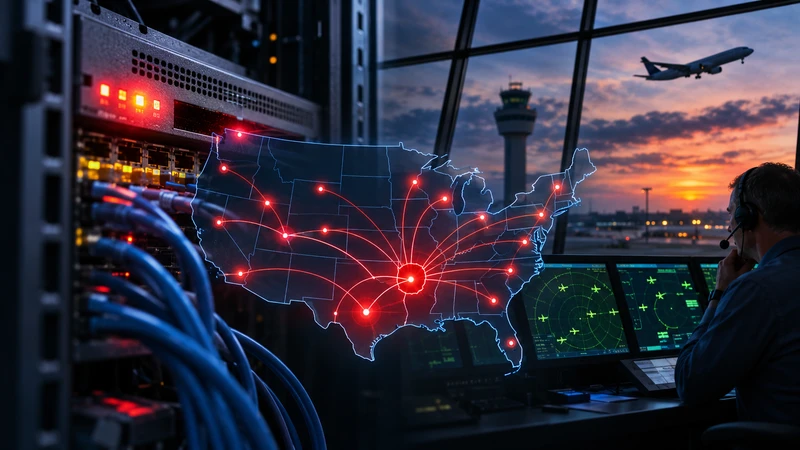
Within hours, 17 of the FAA's 22 en route air traffic control centers were in trouble and every departure in the United States was stopped for more than four hours.
What the router actually did.
It flooded the network.
The FAA's own account puts the rate at about a thousand connection attempts every four to five seconds. The old equipment the new router was talking to could not absorb that, and the instability spread through aircraft communications and radar feeds.
A second site, a radar facility in Amarillo, got pulled into it.
L3Harris, the contractor that owns and operates the FAA's telecommunications network, eventually blocked traffic from both locations. The system stabilized. Flights resumed.
So the fix, at the critical moment, was to disconnect Arkansas and Texas from the national airspace system and see if things calmed down.
They did.
The quote from the guy who does this for a living.
Robert Mann, who founded an airline consulting firm, said the obvious thing out loud.
The idea that you would have a single router take down a national network is just not plausible.
He is not disputing that it happened. He is pointing out that it should not have been possible, which is a different and much worse observation.
A network carrying the communications and radar data for American commercial aviation should not have a single point of failure sitting in a small town in south Arkansas. The whole architectural purpose of redundancy is that one box dying is a Tuesday, not a national event.
And then there is the timing question, which the FAA answered itself.
Buried in the agency's official Q and A is this exchange.
Question: why was the router replacement work done in the middle of the day and not at night?
Answer: maintenance at major air traffic control facilities is typically conducted at night, when there is less traffic. However, based on what happened Friday, we will reevaluate when we do replacement work.
Read that twice.
The FAA has a standing practice of doing this work overnight. They did this one in the middle of a Friday. And the official position is that they will now reevaluate whether middle-of-the-day network surgery on the national airspace system is a good idea.
That is a lesson learned. It is also a lesson that was already known and written down somewhere.
Nobody knows yet whose fault it is.
Investigators are working out whether the router was defective or whether something went wrong during installation. FAA personnel went to the L3Harris lab in Florida to examine both units. The router manufacturer says its equipment worked as configured.
Worked as configured is doing an enormous amount of work in that sentence.
Duffy says that when they determine the root cause, he will tell the public what they find. Fine. We will hold him to it.
Here is why this matters beyond the inconvenience.
This was the second nationwide ground stop since 9/11.
The first one, in January 2023, happened because somebody accidentally deleted a file in the NOTAM system. The corrupted file was also in the backup.
So in the last four years, American aviation has been shut down nationwide twice. Once by a deleted file that was also broken in the backup, and once by a router upgrade at a site chosen specifically because it seemed harmless.
Neither was an attack. Neither was weather. Both were maintenance.
The part that should stay with you.
Everyone involved made a defensible call.
Upgrading from copper to fiber is correct. Starting at a small remote site is prudent. Grounding flights when you cannot trust your radar feeds is exactly right, and the analyst who criticized the architecture went out of his way to say so.
And the whole thing still came apart, because a system that has been patched and extended for forty years has dependencies nobody has fully mapped.
That is the real finding, and it is not about one router.
There are fifty billion dollars being discussed in Washington this week to modernize all of this. Whatever Congress decides about the number, somebody should spend part of it on a complete map of what is connected to what.
They apparently do not have one.
- Article Source:
news.basedapparel.com

- Photo:
