
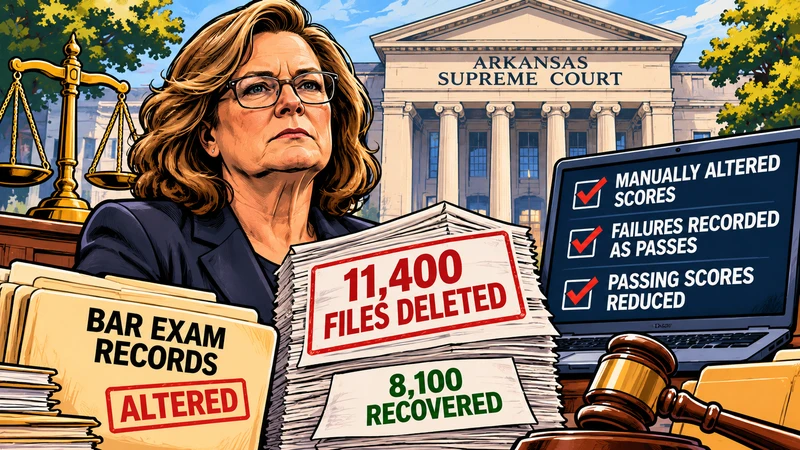
Nancie Givens ran the Arkansas Supreme Court's Office of Professional Programs. Among her duties: safeguarding the accuracy of bar examination results and preserving the records behind them.
She was arrested last Thursday and charged with 65 felony counts of tampering with a public record.
Arkansas State Police and the FBI opened a joint investigation in April. What they say they found spans July 2020 through July 2025.
Manually altered bar exam scores. People who failed recorded as having passed. And, according to prosecutors, people who actually passed having points taken away from them.
Start with the number that should stop you.
Roughly 11,400 electronic files were deleted or made unavailable.
Bar examinee applications. Examinee profiles. Score sheets. Records the Arkansas Supreme Court requires to be retained for twenty-five years.
A forensic examiner managed to restore about 8,100 of them. That is how the discrepancies surfaced, by comparing what examinees actually earned against what the office had recorded.
Eleven thousand four hundred files.
Think about what this means for the people on either side of it.
If the allegations hold, there are people practicing law in Arkansas right now who did not earn a passing score, and who have no idea.
They studied. They sat the exam. They got a letter saying they passed. They were sworn in, hung a shingle, took clients, argued cases, and went home every night believing they had cleared the bar like everyone else.
And there are people on the other end of it who did pass, were told they had not, and went off to do something else with their lives.
Some of them presumably studied again. Some of them paid for another round of prep. Some of them concluded they were not cut out for it.
The Arkansas Supreme Court's own statement acknowledged the profound consequences for affected examinees, the bar and the public. Six justices signed a joint statement calling it, if true, an unprecedented breach of public trust.
To their credit, they also said plainly that the vast majority of people told they passed did, in fact, pass. That is the right thing to say early and loudly, because thousands of Arkansas attorneys woke up Friday wondering about their own careers.
And now nobody can tell anyone anything with certainty.
That is the quiet horror of a records case.
It is not just that some scores were wrong. It is that the documents proving what the scores were got destroyed, which means reconstructing the truth may be impossible for a large number of people.
Arkansas lawmakers are already looking into the validity of admissions during that window. Whatever they conclude, there is no clean answer available. You cannot un-ring a bell when somebody deleted the bell.
The motive is the part nobody has explained.
Prosecutors are not saying how, or why, or who benefited. Will Jones, the prosecuting attorney, would not say how many exams were affected or whether any admissions outcomes changed.
So we are not going to speculate, and Givens is charged rather than convicted and gets the presumption of innocence like anyone else.
But the structure is worth noting. She served in that role since 2013 and spent eighteen years before that as deputy director of a related office.
Thirty-one years inside the same small corner of a state government, in a job where the entire control mechanism was one person's integrity.
Which is the actual lesson here.
Every system has a place where one person is simply trusted.
Somebody has the password. Somebody signs the form. Somebody is the only one who knows how the database works, and has known for a decade, and nobody has ever had a reason to check behind them.
That is not a government problem specifically. It is true at banks, at churches, at nonprofits, and at the company you work for. Institutions run on trust because checking everything costs more than it is worth, right up until the day it does not.
We spent the fall writing about ghost daycares billing for children who were never there, Medicaid claims for deceased patients, $1.3 billion mailed to dead Americans, and a bank fined $1.21 billion for failing to flag five billion in suspicious activity.
Different scale, identical shape. A process nobody audited, running for years, until somebody finally looked.
Sixty-five counts.
The thing that makes this one land differently is who got hurt.
A phantom daycare bills the Treasury. This allegedly took a person who passed a professional licensing exam and told them they failed.
That is somebody's career. Possibly several somebodies'. And the records that could prove it are gone.
Audit the gatekeepers. Especially the ones who have been there thirty-one years and are very good at their jobs.
- Article Source:
news.basedapparel.com

- Photo:
