
Pew Research defines a millennial as anyone born between 1981 and 1996.
Do the arithmetic. The youngest person in that bracket turns thirty before the end of this year.
That means as of New Year's Eve, there will not be a single millennial anywhere in the United States in their twenties. The entire generation, roughly seventy million Americans, has aged completely out of the decade it spent fifteen years being mocked about.
The internet is handling this about as well as you would expect.
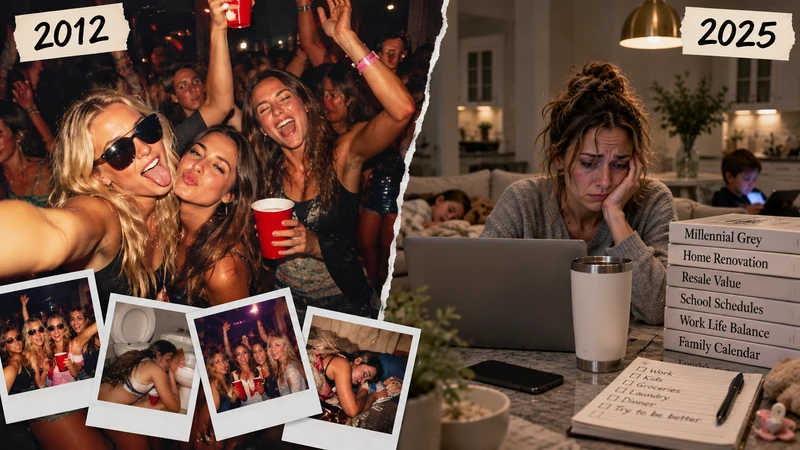
Millennials have spent the week posting through it, and a parallel trend has emerged where they describe what a normal night out looked like in 2012 while Gen Z reads the comments in visible alarm.
Tiny digital cameras. Direct flash. The Valencia filter applied to everything regardless of whether it improved anything. Facebook albums containing one hundred and forty-seven photographs from a single evening, at least one of which shows somebody crying, vomiting, or asleep in a location nobody can identify.
And then the part that genuinely unsettles younger people: all of it was uploaded, tagged, and left up. Permanently. With your full name on it.
One woman summarized the condition this way. Physically she is a 32-year-old mother. Mentally she is still somewhere in 2012.
Gen Z cannot understand it and the reason is interesting.
They look at those photos and see a catastrophic lack of operational security.
They are not wrong. A generation documented its worst decisions in high resolution and then handed the archive to a company that has never deleted anything.
But the reason millennials did it is the part worth noticing. In 2012, nobody was performing. There was no brand to protect, no analytics to check, no concept that a bad photograph could follow you into a job interview twelve years later.
They took the picture because the night happened and somebody had a camera.
Gen Z grew up understanding that everything is content. Which means they take better photographs and have substantially fewer of them, and the ones they have are all of someone standing at a flattering angle in good light.
Millennials have one hundred and forty-seven photos of a Tuesday.
Which generation got the better end of that deal is not actually close.
We wrote earlier this month about millennial grey, the beige-and-greige color scheme that took over American kitchens, cars and rental properties. Eighty-eight percent of vehicles sold globally last year were white, black, grey or silver.
That is the same generation. The people who photographed everything in 2012 and then spent 2022 painting it all the color of a dentist's waiting room.
Something happened in between, and it was not aging. It was resale value.
Somewhere around thirty, a critical mass of people stopped asking whether they liked something and started asking whether the next person would object to it. The photos stopped. The colors went neutral. The playlist became background music.
And now they are running things.
The Economist noted this month that entertainment is leaning hard into 1990s and 2000s nostalgia, because millennials are approaching peak spending power and are now in management-level creative roles.
That is why you are getting sequels to films from 2000. The people green-lighting them were in middle school when the originals came out.
The generation that got called cringe for a decade now controls the budgets, and they are using that control to remake their own childhood.
A closing thought for anybody turning thirty this December.
You are not required to go grey.
The Facebook albums were embarrassing and they were also evidence that you were somewhere, with people, not thinking about how it would look.
Take the bad photo. Buy the red car. Paint the kitchen a color.
Nobody has ever looked back fondly on a decade they spent optimizing for resale.
- Article Source:
news.basedapparel.com

- Photo:
