
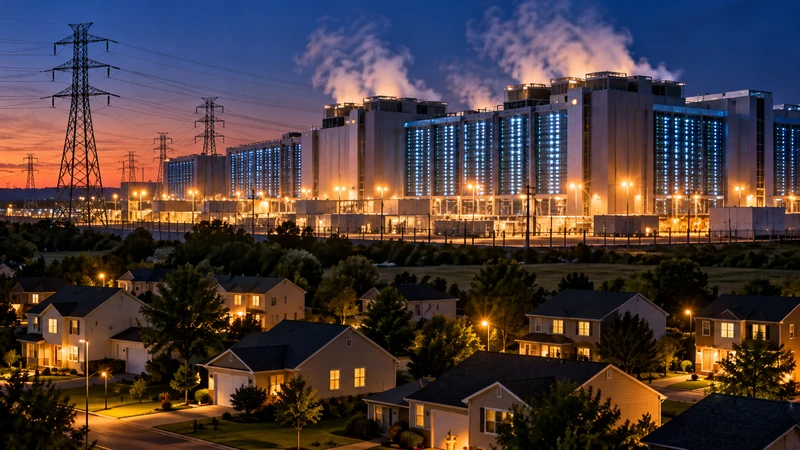
A Columbus research firm ran the numbers on Ohio's data center boom and published them this month. Scioto Analysis, ten thousand simulations, the full cost-benefit treatment.
Here is the sentence that should have led every newscast in the state.
In 2026, Ohio data centers use enough electricity to power 5.7 million homes. Ohio has 5.4 million homes.
The servers are already outvoting the people.
And by 2028, if everything currently planned gets built, the researchers project data centers will consume enough power for roughly three and a half times as many homes as actually exist in Ohio.
The bill.
Scioto estimates that under current policy, higher electricity prices will cost Ohio ratepayers sixteen billion dollars between 2027 and 2034.
That is the number everyone is quoting, and we should be precise about what it is. It is a modeled projection of system costs under a middle-range scenario, not a line item on anyone's October bill. Their estimates ranged from a 5.9 percent increase under low demand to 29 percent under high demand, and they picked the middle at 16 percent. Modeled system costs do not translate one-to-one into retail prices.
Fine. Even granting all of that, the middle scenario costs Ohio families sixteen billion dollars so that some of the most valuable corporations in human history can avoid building their own power plants.
Now the part that makes it art.
Ohio's sales and use tax exemption for data centers cost the state an estimated 1.6 billion dollars in revenue in 2025.
So Ohio is paying them to come.
Read that twice. The state hands out tax exemptions to attract these facilities, the facilities plug into the grid everybody else uses, and the resulting cost increase lands on the ratepayers whose taxes just subsidized the arrival.
You pay to invite them. Then you pay for their electricity. There is no third payment yet but the decade is young.
A prior analysis found that exemptions granted to Google and Meta worked out to roughly one million dollars per job created. One million. Per job. There are universities that would educate a person for less than that and some of them are in Ohio.
To be fair, because somebody should be.
The same study found data centers delivered a net social benefit of about sixty-two billion dollars to Ohio between 2013 and 2026, mostly through 96,000 jobs and seventy-five billion in wages.
That is real. Nobody should pretend otherwise, and the people who want these facilities banned outright are ignoring an enormous amount of actual prosperity.
But watch what happens next in the same report. Going forward, from 2027 to 2034, under current rules, the projected net benefit drops to 2.4 billion dollars. Benefit-cost ratio of 1.04.
Sixty-two billion over thirteen years, then 2.4 billion over the next eight.
The deal was good. The deal is getting worse. That is not an ideological claim, it is arithmetic, and the reason is that the easy gains already happened while the electricity demand is only now arriving at scale.
The fix is not complicated and it is not anti-technology.
Scioto looked at alternatives. The one that produced the largest benefit, forty-three billion dollars, was requiring new data centers to generate their own power on-site rather than drawing from the grid everyone else uses.
Behind the meter. Build your own generation. Pay your own freight.
That is not a regulation that stops anyone from building anything. It is the principle that a business consuming as much electricity as a mid-sized city should supply that electricity rather than socializing the cost across retirees in Zanesville.
The Goldwater Institute, pushing back on the alarm, argues the real problem is an electricity system that hides scarcity from consumers until it surfaces as congestion and higher costs. They are not wrong about that either. A market that priced power honestly would have sorted this out already.
Both things point the same direction. Make the user pay the real cost.
The part nobody in Columbus wants to discuss.
Ohio now has roughly 240 data centers and companies plan to invest up to forty billion dollars more by 2030.
Meanwhile a state representative pushing legislation on this described the situation as a financial crisis developing in real time while the Statehouse fails to respond.
He is right that nothing is happening. Ohio built the tax exemption in 2013 for an industry that barely existed, never revisited it, and is now discovering that the terms of a thirteen-year-old deal might not survive contact with a technology that consumes more electricity than the entire residential sector of the state.
Somebody should probably look at that before 2028, when the servers are projected to need three and a half Ohios worth of power.
They will not need the houses. Just the electricity.
- Article Source:
Based Apparel

- Photo:
