
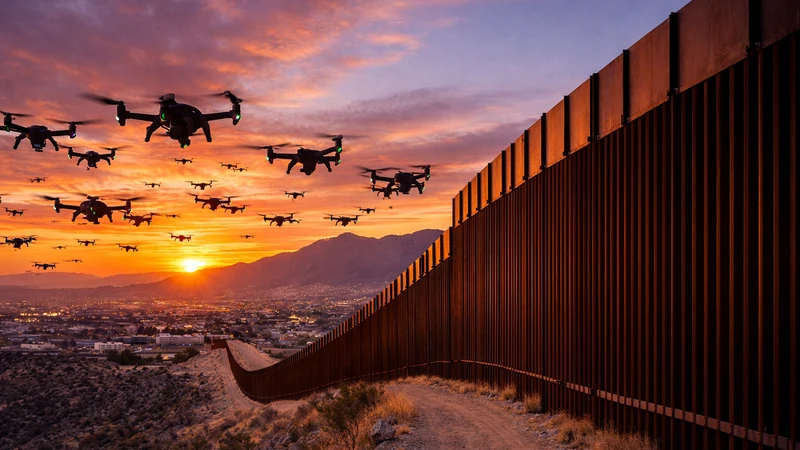
Underscoring Urgent Need for Border SecurityIn yet another alarming reminder of the dangers festering along our southern border, drones operated by Mexican drug cartels breached U.S. airspace near El Paso International Airport this week. Fortunately, the threat was quickly addressed and disabled by the U.S. military, according to the Trump administration.
Transportation Secretary Sean Duffy confirmed that the incursion occurred near the busy Texas airport, prompting the Federal Aviation Administration to temporarily shut down operations late Tuesday. The swift response from federal authorities prevented what could have been a far more serious situation.
“The FAA and the Department of War acted swiftly to address a cartel drone incursion,” Duffy stated. “The threat has been neutralized, and there is no danger to commercial travel in the region.” Airspace restrictions were lifted shortly afterward, and normal flight operations resumed.
While officials have not disclosed how many drones were involved or the precise methods used to disable them, the fact remains: foreign criminal organizations were brazen enough to penetrate American airspace. That alone should concern every citizen.
The FAA initially announced what would have been an unprecedented 10-day closure of El Paso’s airport, citing “special security reasons.” For a city of nearly 700,000 residents—and a major hub for cross-border commerce—such a move would have had serious economic and logistical consequences. Though the closure was quickly reversed, the episode caused understandable alarm throughout the community.
El Paso sits directly across from Ciudad Juarez, Mexico, forming one of the busiest border corridors in the country. This region is vital to trade and travel, but it is also a frontline in America’s ongoing battle against cartel violence and narcotics trafficking. The use of drones by cartels represents a troubling escalation in tactics, showing how organized crime is adapting with modern technology.
On the same day as the incident, Texas authorities were also forced to dispel a fake memo circulating online that falsely claimed road closures in the area. In times like these, misinformation only adds confusion to already serious security concerns.
What this episode makes clear is that the threat at our southern border is not abstract. It is real, evolving, and increasingly sophisticated. Cartels are not just smuggling drugs and exploiting weak border enforcement—they are probing American defenses, testing response times, and pushing boundaries.
The swift military response deserves credit. But reaction is not enough. Prevention must be the priority. Stronger border enforcement, advanced surveillance technology, and firm national security policies are essential to protect American communities and safeguard our sovereignty.
If cartel-operated drones can enter U.S. airspace near a major American city, it is a warning sign we cannot afford to ignore. Border security is national security—and it is long past time we treat it that way.
- Article Source:
news.basedapparel.com

- Photo:
