
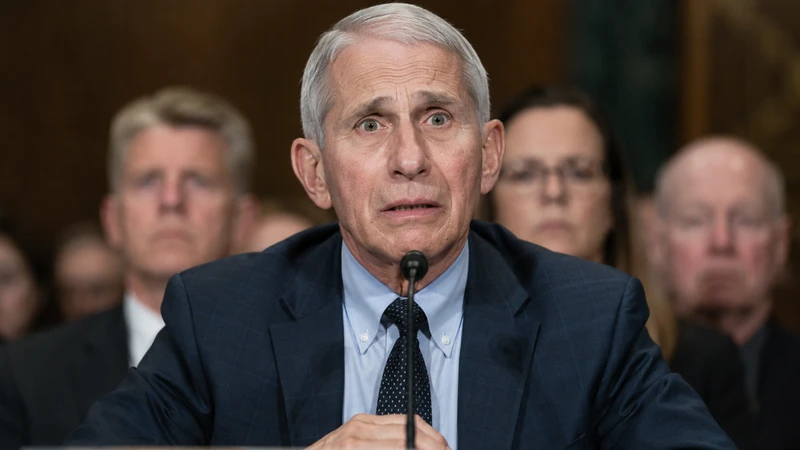
Anthony Fauci has appeared before Congress more than 250 times across nearly four decades of public service. On Wednesday he set a personal record by answering none of the questions.
Appearing under subpoena before the Senate Homeland Security and Governmental Affairs Committee, chaired by Kentucky Republican Rand Paul, the former head of the National Institute of Allergy and Infectious Diseases delivered a statement, accused the chairman of an "obvious obsession with calling for my prosecution," and then invoked his Fifth Amendment privilege against self-incrimination. Then he invoked it again. And again. At one point the chairman was reduced to noting for the record that the witness declined to confirm whether a folder was sitting in front of him on the table.
Take a moment with that one. The man who informed a nation of 330 million people when they could go to work, when their children could return to a classroom, and what substances they were required to accept into their own bodies has now reached the point where the location of office supplies is a matter of grave constitutional sensitivity.
The hearing followed the release of more than a thousand pages of Fauci's contemporaneous diary, composed on a government computer and delivered to the committee by Health Secretary Robert F. Kennedy Jr. Paul contends that the private entries and the public reassurances tell rather different stories, particularly regarding whether the virus wandered out of a laboratory in Wuhan and regarding the gain of function research American taxpayers so generously helped fund. Fauci's representatives maintain that the diary lines up neatly with everything he said at the time.
Wonderful. That is exactly the kind of disagreement a congressional hearing exists to sort out, which makes it a shame that the witness has developed such a sudden and comprehensive interest in the right to remain silent.
Here is the part the wire coverage keeps politely stepping around. Fauci is not an ordinary witness calculating ordinary risk. On his final day in office, Joe Biden signed him a sweeping preemptive pardon covering federal offenses over a span of years ending the instant the pen came off the paper. No charges. No indictment. No trial. A blanket absolution for crimes nobody had bothered to allege, which Fauci accepted with both hands.
The Supreme Court noticed this problem approximately 130 years before it became inconvenient. In Brown v. Walker, decided in 1896, the Court held that a pardoned witness "cannot longer set up his privilege," because as to that offense he stands as though it had never occurred. Justice Marshall restated the rule in a later concurrence, filing a pardon alongside an expired statute of limitations among the circumstances in which a witness can be made to talk. The reasoning is not advanced. The privilege guards you against prosecution. Remove the prosecution and there is nothing left to guard.
Which means Fauci's attorneys have constructed something genuinely impressive. Their client keeps the pardon, which shuts the courthouse door, and he keeps the Fifth, which shuts the hearing room door. Immunity on the way in, silence on the way out, and roughly two years of American life filed under nobody's responsibility.
Paul is not required to admire the architecture. A chairman does not have to treat a blanket invocation as a magic word that ends the proceeding. He should rule on the claim, put his questions one at a time, and direct the witness to answer wherever the pardon has plainly erased any federal exposure. Should Fauci still decline, the Senate keeps a remedy on the books for exactly this occasion. Contempt of Congress under Title 2, Section 192 is a criminal offense carrying up to a year in jail, reached through a committee vote, a floor vote, and a referral to the Justice Department. Paul has spent years announcing that Fauci belongs behind bars. Here is the lawful route to find out, and it runs through a roll call rather than another cable hit.
In fairness, and conservatives ought to want this part right rather than resent it, the pardon does not vaporize the privilege altogether. Eugene Volokh has flagged the caveat that matters, which is that the privilege disappears only when no American government, state or federal, could realistically bring a case. A presidential pardon does nothing about state charges, and Fauci's counsel may well point to conduct falling outside the pardon's stated window. His attorney David Schertler calls Paul's accusations false and disgraceful and promises to examine every option. Fauci denies lying and notes he has answered Congress honestly for decades. Those arguments deserve a ruling rather than a smirk. There is also a less comfortable reason for restraint. The right to remain silent is not a bureaucrat's loophole invented last Tuesday. It is a protection our side has needed before and will need again, and a Congress that tears it up to reach one unpopular witness will find the pieces waiting whenever the gavel changes hands.
Respecting the privilege, however, is not the same as being defeated by it. The answer to a contested invocation is a ruling, not an adjournment. Rule on it. Compel what the law allows. Refer what the law requires. Let a judge decide whether a man carrying a preemptive federal pardon may also carry a Fifth Amendment shield into a Senate hearing.
Americans were instructed to trust the science and denied the paperwork. They are now instructed to trust the pardon and accept the silence. It is a marvelous arrangement for exactly one person.
- Article Source:
Based Apparel

- Photo:
