
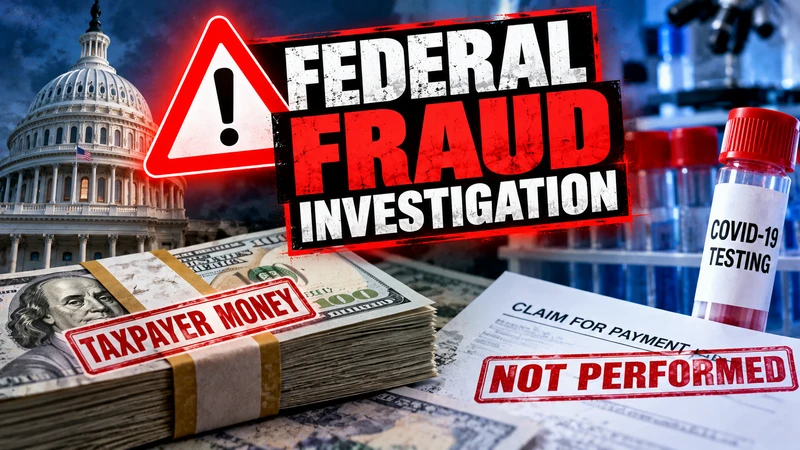
A federal grand jury in Illinois indicted Rajesh Patel, 52, of Schaumburg on Monday.
The allegation is that his laboratory billed a federal program $66.2 million for COVID-19 tests that were never performed.
The government paid $44.1 million of it.
Patel personally cleared roughly $28 million, according to prosecutors. He faces five counts of wire fraud, twenty years maximum on each.
He is entitled to the presumption of innocence and we will extend it, same as we have to everyone else in these pages. But the mechanics described in the indictment are worth walking through, because they explain something larger than one lab in Schaumburg.
The program he allegedly exploited.
During the pandemic, Congress created an HRSA fund so that uninsured Americans could get tested at no cost. A lab performed the test, submitted a claim, and the federal government paid.
Note the design. There was no patient paying a bill who might notice a charge for a test he never took. There was no insurance company with a fraud department reviewing the claim. There was a lab, a form, and a Treasury account.
The only verification in the entire chain was the honesty of the person filling out the form.
And the specimens.
Here is the part that should get attention.
According to the indictment, Patel's lab paid a company called Meridian tens of millions of dollars for collecting test specimens and supplying the lab with those specimens and the biological information of the purported patients.
Purported.
So the structure was: one company supplied names and samples, another company billed the federal government for testing them, and the money flowed based on paperwork that nobody outside the arrangement ever examined.
This is the seventh one we have covered since September.
Twelve people charged in San Diego over daycares that billed more than ten million dollars for children who were never there, including one provider who left the country for a month while deposits kept arriving.
An Arizona scheme that billed Medicaid for addiction treatment never provided, including for patients who were deceased, as part of a scandal that cost that state more than two billion dollars.
Roughly 750,000 ACA enrollments that CMS could not verify, generated by brokers who were paid per signup while eligibility standards were loosened.
A Treasury program that blocked $175 million in payments to dead Americans this year, after an OMB finding that the government had sent $1.3 billion to deceased recipients in a single year.
Thirty thousand self-declared noncitizens added to voter rolls across eleven states, traced largely to DMV software and clerical errors.
A $1.21 billion fine against Bank of America for failing to flag more than five billion dollars in suspicious activity.
And now $66 million in tests that prosecutors say were never administered.
The pattern never changes.
Build a program at emergency speed. Fund it generously. Pay intermediaries per transaction. Verify almost nothing. Audit later, if at all.
Then act astonished when someone fills out the form.
This is not an argument against the program. Uninsured Americans needed testing during a pandemic and Congress was right to pay for it. The emergency was real.
The point is that emergency speed and zero verification are a choice people make together, and the second part is never necessary.
A single automated check comparing claim volume against a lab's physical capacity would have flagged this. Any commercial insurer runs that check continuously, because commercial insurers are spending their own money.
Which brings us back to a comparison worth repeating.
Last week the federal government fined Bank of America $1.21 billion for failing to adequately monitor suspicious transactions.
The standard the government demands of a bank is identity verification, anomaly detection, and mandatory reporting.
The standard the government applied to itself during the pandemic was a form.
The good news, and there is some.
This indictment came out of the Justice Department's National Fraud Enforcement Division, which has produced a run of these cases. The same office recently announced more than $490 million in tax fraud exposed across a six-week surge, including a scheme that sheltered $1.5 billion in income.
Somebody is finally looking. That deserves credit.
It would deserve more if the looking happened before the checks cleared rather than three years after.
Twenty-eight million dollars left the Treasury and went into one man's accounts, according to prosecutors, and the system that let it happen is the same system still processing claims today.
Fine the banks. Then audit the agencies.
- Article Source:
Based Apparel

- Photo:
