
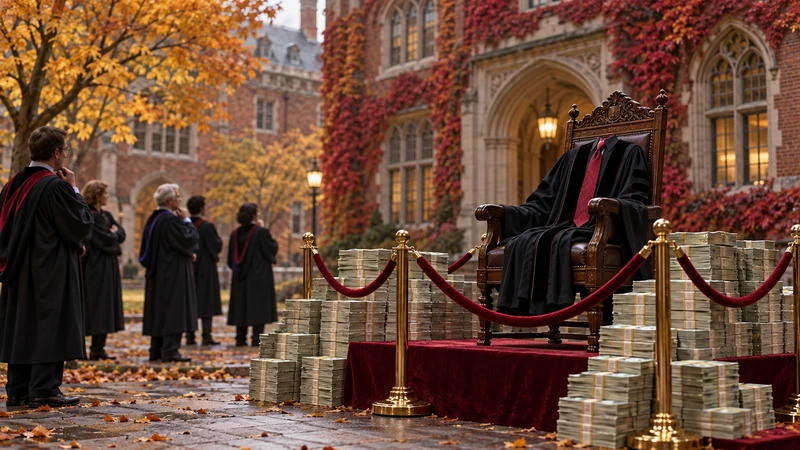
Harvard University is soliciting ten million dollar gifts to endow faculty positions for conservatives.
The program is called viewpoint diversity. President Alan Garber and Provost John Manning are running it. The pitch to donors is that Harvard would like to have some professors on campus who disagree with the other professors, and in order to accomplish this, Harvard will require ten million dollars per attempt.
Ten million. Per conservative.
At that price you could endow a chair, fund a decade of research, and still have enough left to buy every registered Republican in Cambridge dinner. Twice.
Harvard has to fundraise to locate a conservative.
Sit with the premise. One of the wealthiest institutions on earth, with an endowment north of fifty billion dollars, has concluded that acquiring faculty members who hold the political views of roughly half the country requires a dedicated capital campaign.
This is how zoos handle breeding programs for animals that cannot reliably reproduce in the wild.
And the thing is, they are not wrong about the difficulty. That is the funny part and also the depressing part. Harvard genuinely cannot produce a conservative professor through its normal hiring pipeline, because the normal hiring pipeline has spent forty years filtering them out with impressive consistency. The pipeline worked. It worked so well that fixing it now costs eight figures a head.
The faculty's response is the part that deserves framing.
The Harvard Crimson surveyed faculty about the plan.
Forty-seven percent opposed it. Thirty-one percent agreed.
Nearly half the faculty at an institution whose entire stated purpose is open inquiry looked at a proposal to hire people who disagree with them and said no thank you.
Not that it is too expensive. Not that it is poorly designed. Opposed.
These are people who would describe themselves without irony as committed to challenging assumptions and sitting with discomfort, and they were polled on whether a colleague might vote differently and nearly half of them flinched.
Then there is the objection from the left, which is genuinely the best part.
A professor at American University's Antiracist Research and Policy Center described Harvard's fundraising push as a hypocritical DEI hire process for conservative professors.
Read that again.
The machinery gets recognized instantly, correctly, and with total clarity the moment it points the other direction. The targeted recruitment. The donor-funded positions. The explicit demographic goal. The man identified it in about four seconds.
He is also, we would gently note, describing the thing his own field has spent two decades building and defending.
The argument against identity-based hiring is a perfectly good argument. We have made it for years. We are simply noting who else has discovered it this month, and under what circumstances.
A former Colgate professor added a methodological complaint, pointing out that only 463 of more than 1,400 faculty responded to the Crimson survey and just 292 completed it.
Fair enough. Though if the plan were popular, you might expect more people to show up and say so.
And Harvard is thirteen years late.
Peter Wood of the National Association of Scholars pointed out that the University of Colorado Boulder hired its first visiting scholar in conservative thought and policy in 2013.
Boulder. Colorado. Thirteen years ago.
Harvard, which considers itself the intellectual center of American life, is being lapped on viewpoint diversity by a school best known for being on a mountain.
The honest conclusion.
We are not going to pretend this is a bad idea. It is a good idea. It is late, expensive, awkwardly structured and being executed by people who clearly feel they have no alternative, and it is still better than the alternative of doing nothing.
If Harvard wants to hire people who think differently, Harvard should hire people who think differently. Nobody on our side should object to that on principle.
But the next time a university administrator explains that his institution values rigorous debate and the free exchange of ideas, remember that Harvard had to pass the hat to find somebody to debate with.
Ten million dollars, and nearly half the faculty still said no.
- Article Source:
Based Apparel

- Photo:
