
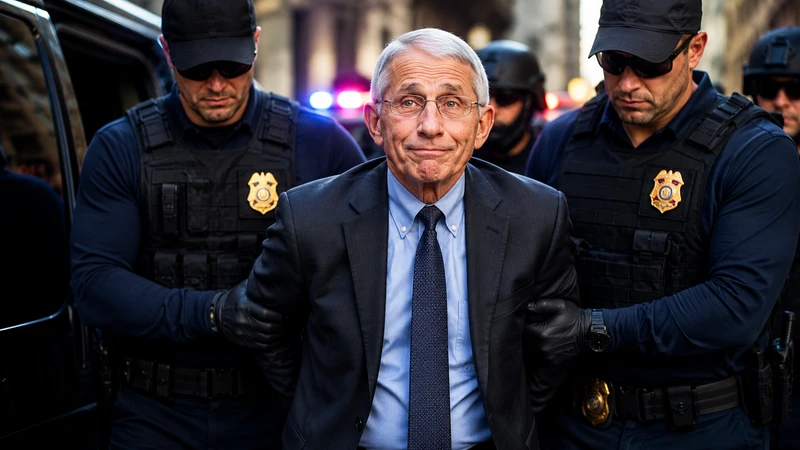
For years, critics have called for accountability. Now, with potential prosecution looming, Americans face a pressing question: Is this the moment the system actually delivers justice, or just another reminder that Washington's most powerful players get to write their own rules?
The possibility of legal consequences for Dr. Anthony Fauci represents a pivotal moment. After nearly four decades as head of the National Institute of Allergy and Infectious Diseases, after commanding the pandemic response with the authority of a modern Caeser, after fundamentally shaping American policy without electoral accountability, Fauci may finally face a day of reckoning. Or he may not. Because this is America, and that's not actually a guarantee.
Let's be clear about what's at stake. Fauci's tenure wasn't just influential. It was transformative. Whether you view that transformation as heroic crisis management or a cautionary tale about unchecked bureaucratic power depends, ironically, on which media ecosystem you inhabit. But what's undeniable is this: A single unelected official made decisions that rippled through millions of American lives, and when those decisions proved questionable, there were remarkably few consequences.
The emails helped. When correspondence emerged showing Fauci's communications during the origins of COVID-19, when he was captured misleading Congress about gain-of-function research, when his position shifted with political winds rather than epidemiological data, suddenly the narrative became less about a public servant and more about a public problem. The evidence was there, documented in his own words.
And now? Now there's talk of prosecution. Grand juries. Legal exposure. The machinery of justice allegedly turning, however slowly.
But here's where skepticism is not just warranted, it's rational: Fauci has resources. Fauci has connections. Fauci has institutional backing from a permanent bureaucracy that protects its own. He's already secured representation, presumably expensive representation. He's had time to prepare, to consult, to position himself as a misunderstood public servant rather than an architect of questionable policy.
Justice for the powerful in Washington moves at a curious speed. It's swift when directed downward, glacial when directed upward. A low-level government employee leaks information? Prosecuted. A cabinet member mishandles classified documents? Endless investigation with an eye toward the next election. A highly credentialed bureaucrat oversees policies that destroy small businesses, separate families, and undermine trust in public health institutions? Well, let's talk about it.
The fair counterargument, naturally, is this: Fauci was operating under presidential authority. He was following scientific consensus, at least the mainstream version of it. He made difficult calls during unprecedented circumstances. Reasonable people disagree about whether he overstepped. And prosecution, critics rightly note, could create a dangerous precedent where every contentious policy decision becomes grounds for criminal liability.
That argument has weight. It does. The challenge is that it hasn't applied equally. When Trump officials faced prosecution, the "just doing their job" defense was deemed insufficient. When Biden officials face investigation, institutional protectors suddenly emerge from the woodwork. Justice shouldn't be a partisan appliance, but it increasingly resembles one.
So the real question isn't whether Fauci broke laws that carry clear definitions. The question is whether our system actually expects accountability from figures at his level, or whether we've collectively accepted that such people operate in a different legal universe than the rest of us.
It's possible prosecution moves forward. Possible a jury decides there's sufficient evidence of wrongdoing. Possible Fauci faces real consequences. That would be remarkable, historically, and it would signal something about this moment in American governance.
It's also possible this fizzles. Charges reduced or withdrawn. Jury unable to reach consensus. Retirement somewhere comfortable, a book deal, a sinecure at some research institution where his legacy is protected by institutional loyalty. That outcome would be more historically consistent.
The system will decide which America we actually live in. The one where even the most powerful answer for their decisions, or the one where power and prestige continue their ancient relationship with impunity.
We'll find out soon enough. Or we'll discover we're still waiting to find out, which would be its own answer.
- Article Source:
Based Apparel

- Photo:
