
For generations, America has celebrated freedom of speech, freedom of conscience, and freedom of religion. Today, many Americans fear those freedoms are increasingly under attack—especially when traditional Christian beliefs collide with politically approved narratives.
That concern is now at the center of a federal investigation involving Major League Baseball.
The Equal Employment Opportunity Commission is examining allegations that Christian players may have faced discrimination after expressing their faith during a Pride Night event. The players did not engage in protests. They did not attack anyone. They simply referenced Scripture and sought to remain true to their religious convictions.
Yet that was enough to trigger controversy.
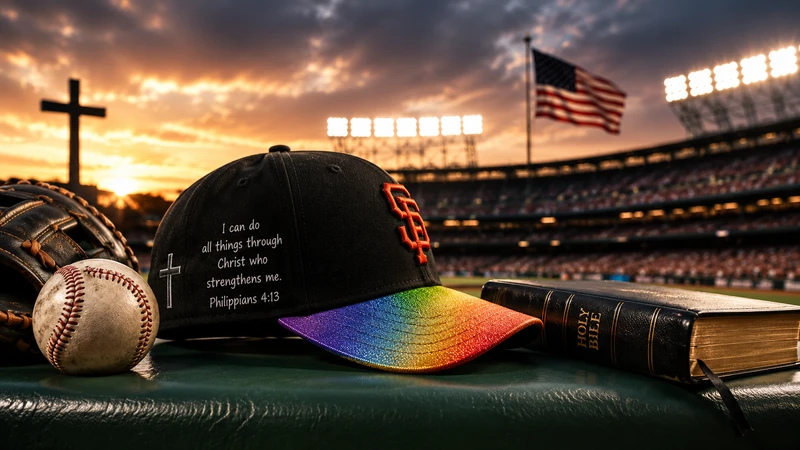
Several San Francisco Giants players wrote Bible verses on their Pride-themed caps as a quiet expression of faith. Another player declined to wear the Pride-themed uniform altogether because it conflicted with his religious beliefs. Their actions were peaceful, respectful, and rooted in convictions shared by millions of Americans.
Instead of celebrating diversity of thought and belief, critics immediately targeted the players, and league officials reportedly warned them for violating uniform policies.
For many Americans, the incident exposes a troubling double standard.
Professional sports organizations routinely encourage athletes to promote social and political causes approved by league leadership. Players wear special logos, participate in awareness campaigns, and are applauded for speaking out on cultural issues. But when Christian athletes express biblical beliefs, they often find themselves facing criticism, backlash, or disciplinary scrutiny.
The message many Americans hear is clear: some viewpoints are protected, while others are merely tolerated.
That is why the EEOC investigation matters.
Federal law does not require Americans to abandon their faith when they walk into a workplace. Religious liberty is not suspended because someone wears a baseball uniform, works in an office, or serves in a public institution. The same civil rights protections that shield other groups apply to Christians as well.
The issue goes far beyond baseball.
Across the country, Americans have watched employees lose jobs, face discipline, or endure public attacks simply for expressing traditional religious beliefs. Parents have seen schools push ideological agendas while treating faith-based perspectives as unwelcome. Churches, families, and religious organizations increasingly find themselves defending rights that were once considered fundamental.
This case has become a symbol of a much larger cultural battle.
At its heart is a simple question: Can Americans openly live according to their faith without being pressured to conform to the political priorities of powerful institutions?
Millions of Christians believe the answer should be obvious.
Tolerance should mean respecting differing viewpoints, not demanding ideological agreement. Diversity should include religious beliefs, not exclude them. And inclusion should apply to Christians just as much as it applies to every other group.
The players at the center of this controversy were not asking for special treatment. They were asking for the freedom to express their faith in the same environment where countless other viewpoints are openly celebrated.
As federal investigators review the case, many Americans see an opportunity to reaffirm a principle that helped build this nation: no citizen should be forced to choose between their career and their conscience.
If religious freedom means anything, it must protect believers when it is unpopular—not just when it is convenient.
- Article Source:
The Post Millennial

- Photo:
