
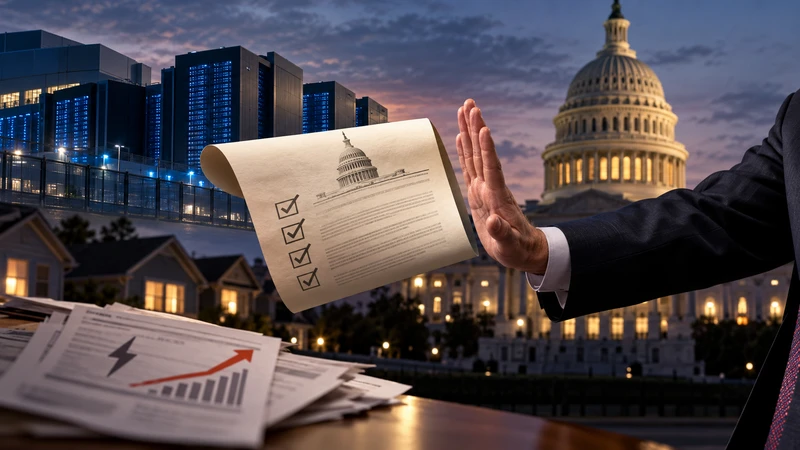
Nine days ago we argued in these pages that data centers had become the sleeper wedge of this election, that voters were connecting them to their electricity bills, and that Republicans needed an answer built on a simple principle: ratepayers should not subsidize the power consumption of trillion-dollar companies.
Jon Husted went and did it.
On Wednesday, Senate Democrats killed it.
The bill, and the vote.
Husted's Ratepayer Protection Act would require state utility regulators and nonregulated utilities to consider standards ensuring that large electricity users, meaning data centers, pay the full incremental cost of the infrastructure needed to serve them. Without those standards, utilities can and do shift that cost onto households through monthly bills.
It passed the House of Representatives on September 16 by a vote of 417 to 3.
Read that number again. Four hundred seventeen to three. Every Republican and nearly every Democrat in the lower chamber. In an election year. On an issue the two parties are actively fighting about.
On Wednesday the Senate voted 57 to 43. Sixty were required to break the filibuster.
Four Democrats crossed over: Ossoff, Warnock, Hassan and Klobuchar. Forty-three did not.
Their stated reason.
Chuck Schumer called the bill toothless, a fraud, and a messaging exercise. His objection is that it requires states only to consider adopting cost-shifting standards rather than mandating them.
That critique is not fabricated. The bill does say consider. Democrats have introduced their own version, from Van Hollen and Heinrich, that would mandate the requirement outright, and they argue Republicans already agreed to stronger language in a separate permitting deal.
Conservatives should engage that argument rather than wave at it, because the answer is better than the objection.
A federal mandate dictating how every state public utility commission must regulate its own grid is precisely the kind of federal preemption we have spent this entire year arguing against. We made that case when the Postal Service tried to commandeer ballot administration, and the Supreme Court agreed 7 to 2. We made it when federal officers were floated at polling places. Electricity regulation has belonged to the states since the beginning, and a bill that compels states to confront the question while leaving the decision with them is the federalist answer, not a watered-down one.
Schumer's complaint is that the bill respects state authority. That is a feature.
Now the part that is purely about the calendar.
Sherrod Brown is running against Husted in Ohio and has attacked him as the point man who brought data centers to the state during his time as lieutenant governor. An internal National Republican Senatorial Committee memo reportedly described data centers as the anchor hanging around Husted's neck.
So the sitting senator with the biggest political vulnerability on this issue wrote a bill to address it, passed it through the House nearly unanimously, and brought it to the Senate floor thirty-four days before the election.
And forty-three Democrats decided he would not be getting that.
They can call it toothless. They cannot explain why 417 House members, including dozens of progressives, voted for a bill so worthless it was not worth passing.
What this hands Republicans, if they use it.
Affordability is the defining issue of this election. Every analyst says so. Democrats have run on it since spring.
On Wednesday, Senate Democrats had a bill in front of them that would push states to make Big Tech pay its own power costs instead of passing them to families, a bill their own House caucus had overwhelmingly endorsed, and they blocked it because passing it would have helped a Republican in October.
That is the ad. It writes itself and it is entirely true.
Husted, to his credit, framed it exactly right on the floor. Big Tech should pay its own way rather than passing costs to local communities. If Democrats block this, he said, they prove they will not take action on affordability.
They blocked it.
One honest caution.
Senators from both parties have signaled that bipartisan permitting reform legislation unveiled this week contains ratepayer provisions, and Mike Lee specifically credited Husted for that language.
If that package moves and the protections survive intact, the policy outcome may land in a better place than Wednesday's vote suggests. We will report that if it happens, and we will give Democrats credit for it if they help pass it.
But that is a bill that does not exist yet, in a Senate with roughly a week of session left before everyone goes home to campaign.
The one that did exist passed the House 417 to 3 and died at 57.
Thirty-four days. Ballots are already out in twenty states.
- Article Source:
news.basedapparel.com

- Photo:
