
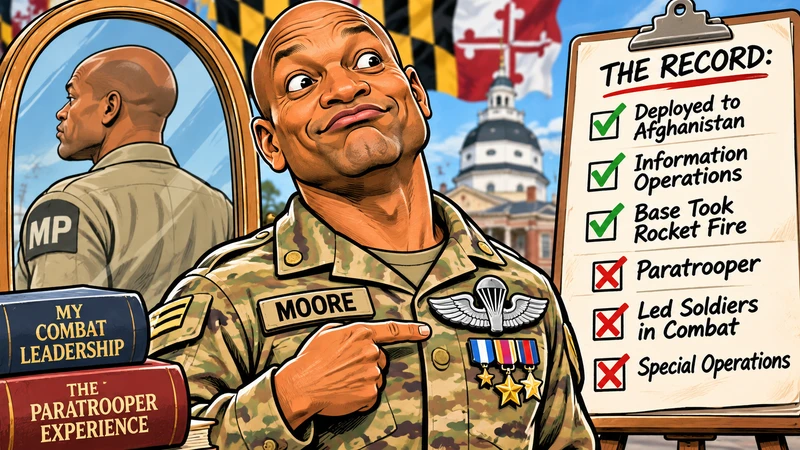
Wes Moore has spent a decade describing himself as an 82nd Airborne paratrooper who led soldiers in combat in Afghanistan.
He said it in his 2022 victory speech after winning the governorship of Maryland. He said it in a 2014 USO interview, where he also described himself as an infantry officer who moved into special operations. He wrote about months of pre-deployment training with the 82nd at Fort Bragg in his 2015 book.
Last week he won reelection easily. He is on every 2028 shortlist in the country.
This week the Army officer who supervised him daily in Afghanistan sat down with the Baltimore Sun and Fox Baltimore and said it did not happen that way.
Who the officer is.
Retired Lieutenant Colonel James Gottschling was Moore's direct supervisor in theater in 2005 and 2006. He signed Moore's 2006 officer evaluation report.
That is not a political opponent, a rival campaign, or an anonymous source. That is the man who wrote the paperwork.
What he said.
Gottschling said Moore served at the headquarters of the 1st Brigade Combat Team, 82nd Airborne Division, working information operations as an attached Army reservist.
He said Moore sometimes left Forward Operating Base Salerno to coordinate with Afghan officials, and that those trips never resulted in any hostile action.
He disputed that Moore was a paratrooper.
He disputed that Moore led soldiers in combat, and said Moore had no troops assigned to him.
His word for the claims was disingenuous. It is disingenuous, he said, to say that you led paratroopers in combat or that you did direct action activities in a combat zone.
Fox Baltimore reports Moore's records confirm he completed officer training in the military police specialty. They found no records substantiating the Fort Bragg pre-deployment training described in the book.
And here is the part that makes this worth writing about.
Gottschling did not come out swinging.
He said Moore's service in a combat zone is something he can be proud of. He called him a valued member of the brigade staff.
Then he said this: it is really the embellishment.
Read that again, because the old soldier just handed the governor a complete exit. Your service was real. Your service was honorable. Stop adding to it.
That is about as gracious as a correction gets, and it came from a man with every right to be considerably less generous.
What was actually true, and it was enough.
Moore deployed to Afghanistan for roughly seven months. He was awarded the Combat Action Badge for rockets landing on his base at Salerno on December 9, 2005.
Rockets landed where he was. That is real. That happened.
He volunteered. He went. He came home.
Here is the thing that should bother anybody who has worn a uniform or loved somebody who did. That story is good. A twenty-something staff officer running information operations out of a forward base that takes rocket fire is a man doing his job in a dangerous place, and this country would have been proud of it without a single addition.
Nobody needed the paratrooper wings. Nobody needed the troops he did not have. The actual record was already something to be proud of, and the embellishment is the only reason anyone is talking about it this week instead of leaving him alone.
The broader thing, which is not about one governor.
There is a particular kind of resume inflation that happens around military service specifically, and it is worse than the ordinary kind.
When a man exaggerates his business record, the cost is to investors and to the truth. When he exaggerates his combat record, the cost falls on everyone who actually did the thing he is describing.
Every man who genuinely led a squad through a contact in Afghanistan had his experience borrowed a little bit when somebody else claimed it without having been there. That is why the veteran community reacts to this the way it does, and why it is one of the few charges in American politics that does not break cleanly along party lines.
Moore's response.
He has said he regrets it, called it an honest mistake, and noted it was nearly twenty years ago.
Fine. Twenty years is a long time and memories drift.
Except a man does not accidentally say he led soldiers into combat in his own victory speech. That is not a slip in a long interview. That is a sentence somebody chose, in a prepared address, on the biggest night of his career.
His supervisor already told him what the honest version sounds like. He even supplied the adjective.
Honorable service. In a combat zone. Under rocket fire.
That is the whole story and it was always good enough.
- Article Source:
news.basedapparel.com

- Photo:
