
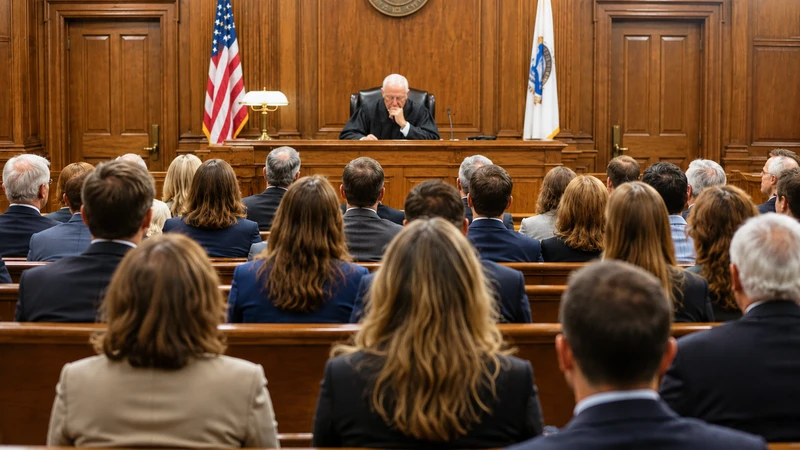
The line to get into Plymouth County Superior Court this morning reached the parking lot. Not one empty seat inside. Twenty-two days of testimony came down to two hours of closing arguments, one hour to each side, and then Judge William Sullivan finished reading the law aloud and sent the jury out at 12:34 p.m.
Eighteen jurors sat through this trial. Six of them learned this afternoon they were alternates, selected out at random by the court clerk after five weeks of listening. Twelve are now in a room deciding what happened in a house in Duxbury on January 24, 2023.
Cora. Dawson. Callan. Three children strangled by their mother, who does not dispute doing it.
What the jury actually has to decide.
Three verdict slips. One for each child. On every slip, five options: not guilty, not guilty by reason of lack of criminal responsibility, guilty of manslaughter, guilty of second-degree murder, guilty of first-degree murder.
Fifteen decisions. Each one about a specific child.
And here is the piece almost nobody watching this understands, because it runs against everything television has taught us about insanity defenses. The burden does not sit on Lindsay Clancy. Judge Sullivan instructed the jury that the Commonwealth must prove she was not suffering from a mental disease or defect so severe that she could not appreciate the wrongfulness of what she was doing or conform her conduct to the law.
Read that again. The prosecution has to prove she was sane. Not the other way around.
If the jury finds her criminally responsible on first-degree murder, the sentence is mandatory life. If it finds her not criminally responsible, she goes to a state psychiatric facility and stays until she is determined to be no longer mentally ill and dangerous, which could be a very long time or not.
What the prosecution told them.
Jennifer Sprague built her closing on sequence and intention. She argued Clancy sent her husband out for takeout food specifically to create the window, and pointed to evidence that Clancy checked a map to calculate how long the errand would take. She argued Clancy began with the child most likely to struggle, and did it away from the others. She told jurors each child was strangled for as long as thirty seconds, and that Clancy kept going to be certain.
Sprague's argument on the medical evidence was that Clancy moved between providers and withheld information because she wanted to recover on her own terms, and that as a labor and delivery nurse she understood better than most patients what following a prescription means.
Then she closed on the basement, and told the jury Clancy left her children there like broken toys.
What the defense told them.
Kevin Reddington did not dispute that Clancy killed her children. He argued she was a devoted mother in the grip of a psychosis nobody caught in time, and that the tragedy is what surrounded her rather than what was inside her. She was reaching out for help, he told the jury, and she was not getting it.
He attacked the police investigation. He condemned the providers who prescribed to her across those months. He went after the credentials of the prosecution's experts, including on Wednesday, when an FBI forensic psychiatrist testified that Clancy had the capacity to know right from wrong.
Why this one is wrenching for the country, not just for twelve people in Plymouth.
Most trials ask whether somebody did something. This one asks what a person is, and whether the law can tell the difference between a monster and a catastrophe.
Both answers are unbearable in their own way. If the jury says she knew, then a mother calculated the drive time to a takeout restaurant and used it to kill her children one at a time, and there is no comfort anywhere in that. If the jury says she did not know, then a woman with limited psychiatric history was handed prescriptions by providers who were not talking to each other, deteriorated in front of a husband who kept reporting it, and three children died inside a failure that nobody has been charged with.
Americans have been arguing about this case for three years because most of us cannot fully commit to either answer. The verdict form does not offer that option.
One thing worth remembering while we wait.
Judge Sullivan told these jurors he had never seen a more dedicated group in any trial he had been part of, and asked them to decide on the evidence rather than on bias.
They did not ask for this. They sat through five weeks of the worst testimony a courtroom can produce, and six of them were sent home this afternoon before they got to weigh in at all. Whatever comes back, and whenever it comes, it will have been reached by twelve ordinary people who were handed something nobody should have to carry.
The rest of us get to have opinions. They have to sign the slips.
If you or someone you know is struggling, call or text 988 to reach the Suicide and Crisis Lifeline.
- Article Source:
FAFO Files

- Photo:
