
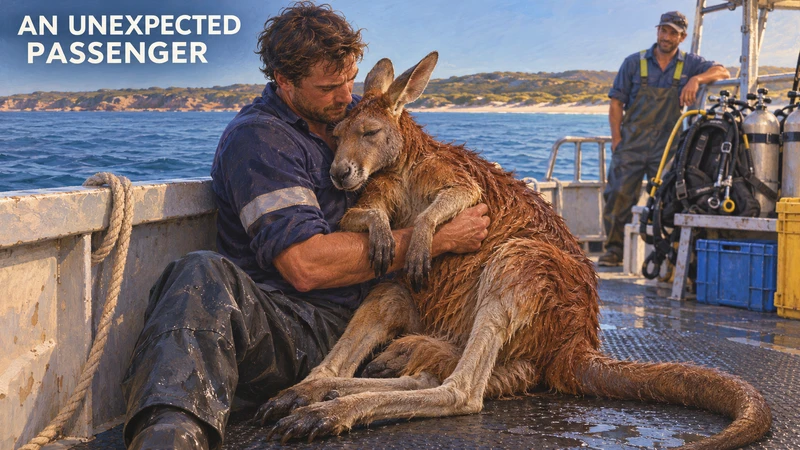
Boston Bay, off Port Lincoln in South Australia. Seven in the morning. A dive crew is prepping gear for a routine kingfish farm inspection.
The skipper, Ryan Smith, turns around and says he thinks he just saw a kangaroo.
The response from his crew, per Jake Murray, who was on the boat:
"Yeah, sure. All right, Ryan, sure."
They doubled back anyway.
It was a kangaroo.
Roughly two miles from land.
Three kilometers. A male red kangaroo, paddling in open water, nowhere near anything a kangaroo has any business being near.
Murray's assessment was that the animal was, in the technical Australian terminology, pretty knackered and pretty waterlogged.
They lowered the boat's sea door, which drops to water level, got their arms under his and lifted him aboard.
Then Murray sat there and held him for the ride back.
"Honestly, I was just kind of cradling him there for a while, and it was almost like he was having a little nap."
A grown man cradling a soggy marsupial on the deck of a fishing vessel. There is a photograph. It is exactly what you are imagining.
The part Murray was very careful about.
He kept a firm hold the entire trip, and not out of sentiment.
A red kangaroo is the largest marsupial on earth and the largest land mammal native to Australia. Its legs are built for covering twenty-five feet in a single hop. Murray described them as powerful and mighty, which is a polite way of saying that a frightened kangaroo on a boat deck is a serious problem with a tail.
So he hugged it. For a couple of miles. Firmly.
That is the whole rescue. A man holding a wet kangaroo very carefully while a boat drives slowly toward a beach.
One crew member had a particularly good morning.
Miguel Villarroel is a diver originally from the Galapagos Islands.
He has been in Australia for a while. He had never seen a kangaroo.
Not at a zoo. Not in a field. Not once.
His first one was two miles offshore, in the ocean, being lifted onto a boat by his coworkers.
Imagine the mental adjustment required. You move to a new country, you wait to see the famous animal, and when it finally happens the animal is swimming.
He presumably now believes this is normal. Nobody should tell him otherwise.
Nobody knows why.
That is the actual mystery and the crew has no answer.
Murray noted the water was unusually calm that morning, and suggested tidal currents might have helped the animal get further out than it otherwise could have. But how a land animal ended up two miles into a bay in the first place is unexplained.
His preferred theory, offered with no evidence whatsoever, is that the kangaroo was a teenager trying to impress his friends.
That is not science. It is also the only explanation anyone has produced.
It ended well, which is the point.
They took him to a beach and set him down.
He sat there for a while, which anyone would, and then hopped off into the scrub under his own power.
The crew never did inspect the fish farm.
Why this is worth five minutes of your day.
Four men were on their way to work. They had a schedule. There was a job waiting and presumably somebody expecting them.
Their boss saw something improbable in the water, they went back to check, and then they spent the morning driving a kangaroo to shore instead of doing what they were paid to do.
Nobody filmed it for engagement. Nobody made a statement. One of them held a soaking wet animal against his chest for two miles because that was what the situation required.
Then they all went home.
Somewhere in South Australia right now there is a kangaroo who has a story none of his friends are going to believe.
- Article Source:
news.basedapparel.com

- Photo:
