
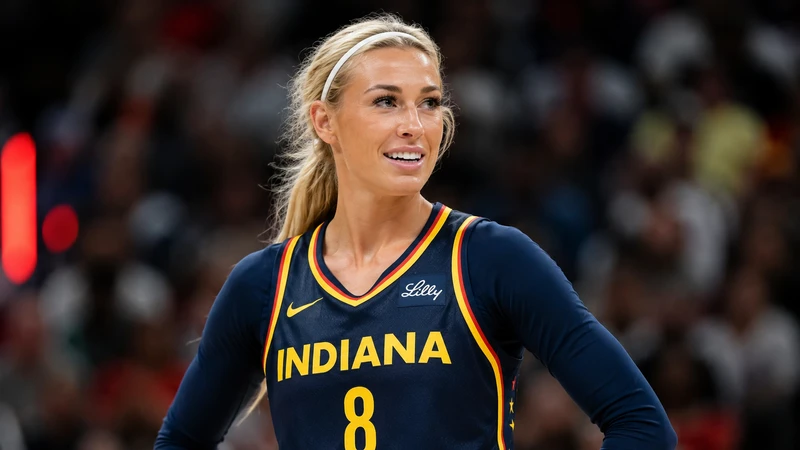
Every so often a public figure says something so wildly, dangerously controversial that the entire sports world stops spinning to process it. This week, Indiana Fever guard Sophie Cunningham delivered just such a bombshell. Brace yourself, because it is a doozy: she thinks women's sports should be played by women. Somewhere, a fainting couch is being wheeled into an ESPN green room.
Cunningham dropped this radioactive take before her team's Wednesday game against the Connecticut Sun, and when reporters gave her the chance to walk it back, to soften it, to issue the traditional hostage-video apology we have all come to know and love, she declined. "I said what I said," she told them, with the unbothered energy of a woman who has clearly never once opened her own quote-tweets. "I think it's kind of common sense." Common sense. In this economy. The nerve.
Here is what makes the whole spectacle so delicious. Cunningham did not chain herself to a goalpost or storm a legislature. She simply stated a thing that roughly the entire population of youth soccer moms mutters into their travel mugs every Saturday morning. And yet you would think she had proposed abolishing the forward pass. She even had the audacity to describe herself as "not a very political person," which is athlete-speak for "I would very much like to keep my endorsements, thank you," and honestly, fair enough.
Then she went and cited Title IX, which is a bit like bringing a footnote to a food fight. "If Title IX and women's sports weren't protected, then you wouldn't hear about any type of women in sport," she pointed out, apparently unaware that in modern discourse you are not allowed to reason from the actual purpose of a law. The whole point of a women's category, she suggested, is that it be, and stay with me here because this is advanced material, a category. Radical stuff. Someone alert the philosophy departments.
The truly infuriating part, for her critics anyway, is that Cunningham refused to play the villain they had cast her as. "I extend love, and I don't dislike anyone," she said. "I think there's room for absolutely everyone here." She even floated the deranged notion that if people sat in a room and talked to one another, they might find they have things in common. Imagine. Dialogue. In the year 2026. You can practically hear the discourse-industrial complex sighing in disappointment. There is no rage-bait to harvest from a woman who keeps saying she loves everybody.
This all followed an ESPN sit-down where she addressed the accusation that she secretly harbors hatred in her heart. She noted she had gotten a mountain of feedback insisting she despises a group of people, to which she responded, reasonably, that she had never said anything of the sort. Her actual crime, it turns out, was wanting young girls to not have to compete against biological males, a position so beyond the pale that it is shared by, oh, most of the country and a decent chunk of the planet. Monstrous.
Predictably, the internet split into its two customary teams. In her corner stood a cheering section that included high school athlete Briley Lechner, who said the comments meant more than Cunningham will ever know and expressed hope that maybe, just maybe, people will finally listen now that a WNBA star said it out loud. Author J.K. Rowling, who has spent the last several years being professionally unbothered on this exact subject, also swung by to lend a supportive retweet, as is tradition.
Now, in the interest of fairness, and because even a sarcastic column has to eat its vegetables, the other side does have a point worth hearing. WNBA player Brianna Turner pushed back, noting that transgender athletes are a vanishingly small slice of the population yet somehow occupy a gigantic share of the national attention span. In her eight seasons, she said, the league has had exactly one openly transgender player, who "caused zero problems." It is a genuine argument about proportion, and its defenders reasonably ask why so much oxygen gets spent on so few cases.
Which is a fair question, right up until it collides with the difference between how often something happens and whether the principle behind it holds. Cunningham's whole case is not "this is a common crisis." It is "the standard is worth keeping regardless of the head count," because the point of a protected category is to protect it before the numbers make headlines, not after. You can debate the frequency all day. The principle sits there unbothered, much like Cunningham herself.
And that, in the end, is the real scandal here. Not that she said something hateful, because she did not. Not that she said something false, because Title IX begs to differ. The scandal is that a professional athlete looked at a bank of cameras, said an ordinary true thing, extended an olive branch to the people mad at her, and then absolutely refused to grovel about any of it. In 2026, apparently, that is the most shocking play in the game. I said what I said. Turns out, so did she.
- Article Source:
The Post Millennial

- Photo:
